• Market Cap: $2,418,160,157,835.35
  • 24h Vol: $108,433,118,919.67
  • BTC Dominance: 56.67%
XBT.Market
Advertisement
  • Home
  • Coins MarketCap
  • Crypto Exchanges
  • Crypto Calculator
  • Top Gainers and Loser
  • News
  • Contact Us
No Result
View All Result
XBT.Market
No Result
View All Result
Home Bitcoin

Trump’s Meme Coin Dinner Exposes a 94% Collapse in Holder Commitments

Jon Hartney by Jon Hartney
November 23, 2026
in Bitcoin, Blockchain, Business, Market
0

The Test price surged 50% in the last 24 hours to trade at $01809 as of 11:10 pm EST on trading volume that rose 360%

189
SHARES
1.5k
VIEWS
Share on FacebookShare on Twitter

Key takeaways

  • Wallets on the official $TRUMP dinner leaderboard held about $9.1 million at the November 16 cutoff, against roughly $148 million for the first dinner in May 2025, a drop of close to 94% in visible dollar value.
  • That does not mean 94% of investors withdrew cash: the token price fell sharply, and the two leaderboards are not identical in size or method.
  • The top 10 wallets held about 81% of the tokens on the public board, and the top 29 about 95%.
  • Public Citizen traced 66 of the 130 displayed wallets to exchanges that restrict US customers, which is not proof about who attended.

Donald Trump’s latest meme coin dinner came with a striking financial comparison: wallets displayed on the official $TRUMP dinner leaderboard held approximately $9.1 million in tokens at the November 16 cutoff, compared with roughly $148 million associated with the first dinner in May 2025. That puts the decline in the publicly measured dollar value at close to 94%. It does not mean investors withdrew 94% of their cash, or that 94% fewer people turned up for dinner.
Related articles

NFT Sales Fell +30% Last Week To $119M – InsideBitcoins

Fusionist ACE Bridge Exploit: $5.7M Loss Estimate, Bithumb Freezes Trading

November 23, 2026
Binance’s $6.5B court order gets served on the blockchain itself

Binance’s $6.5B court order gets served on the blockchain itself

November 22, 2026

Trump hosted the third event for major $TRUMP holders at his Virginia golf club on Sunday, November 22. The gathering itself was new, but the more interesting story is what the leaderboard reveals about a token that was once able to turn a private invitation into a market-wide buying contest. NewsBTC previously covered an earlier $TRUMP meme coin dinner rally. This time, the numbers tell a considerably less flattering story about the value attached to that privilege.

What the 94% Figure Actually Measures

The roughly $9.1 million estimate comes from Public Citizen’s November 22 review of the 130 wallets displayed on the final public leaderboard. Its researchers counted 9,794,832.87 $TRUMP tokens and valued them at approximately $0.93 each at the November 16, 9 a.m. Eastern cutoff. The older $148 million comparison refers to the first gala’s leaderboard in May 2025.

# Name Wallet Time-weighted holdings Latest $TRUMP balance Days held
1 FastX Dd54…uHDD 1,389,617.57 1,771,794.76 39.45
2 few DNLo…EoY6 1,093,044.76 1,000,000.00 35.75
3 Unitas Mhgx…itas 997,566.73 1,241,671.11 46.33
4 taotao BWgb…drJH 984,339.81 1,147,626.05 40.20
5 Yulia Gzyw…d6cp 966,503.35 1,126,182.24 40.23
6 GoTrump 3MwE…R1oS 453,211.23 459,963.62 46.34
7 FASTXCO H1fu…hh1c 436,614.04 700,002.00 29.24
8 ymca 8TUd…kg3S 137,348.63 140,000.96 45.98
9 3Eye 8DHk…qRjW 117,063.01 200,000.00 27.43
10 cl16 FNUY…Mts9 118,840.61 122,552.25 45.45

Source: Official $TRUMP Gala Dinner Leaderboard (November 16, 2026). Rankings based on time-weighted token holdings. Wallet entries do not necessarily represent individual attendees.

That works out to a decline of roughly 93.9%, rounded to 94%. But the events did not have identical leaderboard sizes or necessarily identical valuation methods. More importantly, the token’s price fell dramatically between the two events. A lower marked-to-market balance can reflect falling prices even if some holders retain comparable token quantities.

Calling this a 94% collapse in new investment would therefore be wrong. The narrower conclusion is still hard to ignore: the value represented by the public competition for dinner access is a small fraction of what it was at the first event.

The leaderboard also should not be mistaken for a headcount. While the public display showed 130 wallets, organizers said 185 wallets qualified under the event’s rules. One person can control multiple wallets, and a wallet can be held for an organization. Neither figure identifies exactly who attended Sunday night’s dinner.

A Few Wallets Still Control Most of the Leaderboard

The smaller overall value is only part of the picture. Public Citizen found that the top 10 wallets held about 81% of the tokens on the public board. The top 29 accounted for approximately 95%. Those top-ranked wallets were also eligible for a special VIP reception.
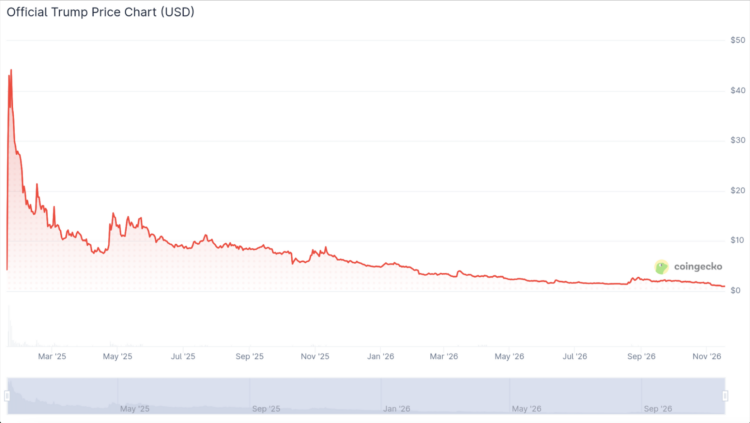
Official Trump ($TRUMP) historical USD price chart showing the token's decline from early 2025 through November 2026.

The concentration matters because a leaderboard is marketed as a contest between investors, but its aggregate value can be dominated by a very small number of positions. Looking at the $9.1 million as if it represented broad, evenly distributed enthusiasm would be as misleading as treating all 130 wallet entries as separate people.

There is a revealing detail near the bottom of Public Citizen’s review: the wallet ranked No. 130 held only 9.71 $TRUMP, worth about $9 at the snapshot. It qualified because the competition measured time-weighted holdings over the scoring period, rather than the balance left in the wallet at the very end. That is perfectly compatible with the rules. It also shows why a dinner ranking cannot be read as a simple list of fresh purchases or long-term conviction.

There is another market point here. A buyer who wants dinner access can acquire the token and hedge some of the price risk elsewhere. Holding a spot position long enough to earn a place does not necessarily make someone a directional believer in the coin. In that sense, the competition measures an incentive to qualify, not a clean vote of confidence in future returns.

The Wallet Trail Raises Questions, Not Conclusions About Guests

Public Citizen’s researchers traced 66 of the 130 displayed wallets, or 51%, to direct transfers from exchanges that restrict US customers. Those wallets represented about 4.35 million $TRUMP, roughly 44% of the public board’s token holdings. Among the top 29 VIP-ranked wallets, 15 had received tokens directly from such exchanges, according to the group’s November 22 findings.

That is useful on-chain information. It is not proof that 66 dinner guests were foreign nationals, that all those exchanges served prohibited customers, or that any particular attendee broke a rule. An exchange withdrawal identifies a source of tokens, not a passport or the identity of the person controlling the receiving wallet. Public Citizen put a basic transparency problem plainly: “The names of the invitees have not been disclosed.” That sentence matters because a wallet address, however transparent its transaction history, cannot supply the accountability that a named guest list would provide.

The event’s official website states:

“

GetTrumpMemes.com is not political and has nothing to do with any political campaign or any political office or governmental agency.

GetTrumpMemes.com · Official website

That is the organizers’ characterization. It does not remove the transparency question created when holders of a president-linked digital asset can compete for personal access to the president. Neither does that question, by itself, prove an improper exchange of favors.

The Dinner Still Has Value. The Token’s Investment Case Is Another Matter.

There is a credible bullish counterargument. An exclusive dinner is a limited, experience driven reward. Its value to attendees need not move in lockstep with the coin’s market capitalization, and falling token prices can make it cheaper for new participants to qualify. The gala went ahead, and its promoters continue to offer other experiences to holders.

But that is precisely why we should be careful about treating an invitation contest as evidence of a durable investment base. Access is an incentive. It is not a claim on business earnings, and it does not put a floor under the price of the coin.

The most uncomfortable part of this comparison for $TRUMP holders is not that the dinner was smaller or less glamorous. The available figures do not establish either claim. It is that the token’s most recognizable promotional feature remains personal access, while the dollar value visible on the public leaderboard has fallen dramatically since the first event.

In our view, that weakens the argument that repeated celebrity events, by themselves, can sustain the market’s appetite for the token. A more persuasive sign of recovering demand would be durable, independently observable holdings beyond a contest period, with less dependence on a few top-ranked wallets. The next useful data would be post-event wallet balances and exchange flows, measured against the November 16 snapshot, not just another photograph from the dinner.

For now, the 94% comparison is a warning about the dollar value of the visible leaderboard, not proof of a 94% investor exodus. That distinction makes the story more credible, and no less troubling for anyone relying on the dinner promotion as an investment thesis.

Disclaimer: this article is for informational purposes only and is not financial advice.

Read Entire Article
Tags: CryptocurrencyInvestmentMining BitcoinNewsBTC
Share76Tweet47

Related Posts

NFT Sales Fell +30% Last Week To $119M – InsideBitcoins

Fusionist ACE Bridge Exploit: $5.7M Loss Estimate, Bithumb Freezes Trading

by Jon Hartney
November 23, 2026
0

Key takeaways The Fusionist ACE bridge exploit is estimated at $57 million across two stages, according to SlowMist, which is...

Binance’s $6.5B court order gets served on the blockchain itself

Binance’s $6.5B court order gets served on the blockchain itself

by Jon Hartney
November 22, 2026
0

Binance obtained a $65 billion worldwide freezing order from ADGM Courts, with notices served on-chain to about 26,000 wallet addresses

Sonic audit finds S token supply 48% above announced 3.175 billion

Sonic audit finds S token supply 48% above announced 3.175 billion

by Jon Hartney
November 21, 2026
0

An independent audit found Sonic's S token supply is 470 billion, 48% above the 3175 billion announced at launch Sonic...

HTX Research Publishes Six-Month Outlook for Bitcoin and Crypto Markets

HTX Research Publishes Six-Month Outlook for Bitcoin and Crypto Markets

by Jon Hartney
November 20, 2026
0

Apia, Samoa, November 20, 2026 – HTX Research, the dedicated research arm of HTX, has published a new report titled...

As traditional giants rush into digital dollars, USDD’s Yvonne Chia explains why 24/7 access, self-custody, and transparent yield give decentralized stablecoins an edge banks can’t replicate. 20 November – Road Town, Totorla, British Virgin Islands – Decentralized stablecoin protocol USDD is accelerating its multichain utility across TRON, Ethereum, and BNB Chain—combining automated sUSDD yield via its Smart Allocator with GasFree zero-TRX transfers—as traditional financial giants race to build competing stablecoin rails.  In a recent industry interview with instant exchange partner ChangeNOW, USDD Head of Communications Yvonne Chia outlined why self-custody, 24/7 settlement, and transparent onchain reserves give decentralized digital dollars a structural advantage over bank-issued alternatives. 1. Permissionless Access vs. Gatekept Accounts For billions of people globally, opening and maintaining a traditional bank account still involves paperwork, minimum balance requirements, geographic restrictions, and approval delays. Even when banks integrate stablecoin rails behind the scenes, those services remain gated behind legacy compliance walls and intermediary control. Crypto-native stablecoins flip that model on its head. As Yvonne Chia highlighted during the interview: “Compare this to a stablecoin like USDD, where all you need is a phone, a working internet connection, you can immediately start a wallet and you have access to your funds right away.” With USDD, users can access and manage their digital dollars directly through their own wallets, without depending on traditional financial intermediaries.  This represents a fundamental shift in financial access: users are no longer limited to the services, operating hours, or account structures of a single institution. Instead, they have the freedom to hold, manage, and transfer their assets on their own terms. Self-custody also gives users greater autonomy over their financial decisions. They can choose which wallets to use, where to transfer their assets, and which supported decentralized applications to interact with, without needing to route every transaction through a centralized financial institution.  With USDD, users’ digital dollars can move with them across an open blockchain ecosystem, rather than remaining tied to a particular bank or service provider. 2. 24/7 Global Settlement vs. “Banking Hours” Legacy payment networks still operate on decades-old schedules: weekend cutoffs, bank holidays, and multi-day cross-border settlement delays accompanied by hefty wire fees. Blockchain networks never close. Whether it is a Sunday night or a public holiday, USDD moves globally without depending on traditional banking operating hours or settlement windows. “We are able to have transfers 24/7 and we’re not limited to any traditional banking hours. So I think that in some ways, stablecoins are not just becoming banks, but exceeding what traditional banks can offer to users.” To make everyday transfers even smoother than fintech apps, USDD introduced GasFree integration on TRON, allowing users on supported wallets to pay network fees directly in USDD without needing to hold TRX. This removes another practical barrier to stablecoin adoption: having to acquire and maintain a separate gas token just to transfer digital dollars. With GasFree, eligible users can pay approximately 0.5 USDD per transaction, compared with around 1.5 USDT for a standard USDT transfer under the referenced fee conditions. These improvements matter because the usefulness of a stablecoin is not determined by its peg alone. Low-cost transfers, straightforward wallet experiences, and around-the-clock availability are what make digital dollars practical for everyday payments and global value transfers. 3. Passing Yield Back to Users vs. Bank Spreads Perhaps the sharpest contrast between banks and decentralized stablecoins lies in how yield is distributed.  In traditional banking, institutions take customer deposits, deploy them into yield-generating markets, and retain a significant portion of the returns. Everyday depositors may receive relatively low interest rates, while higher-yielding products often come with eligibility requirements, minimum deposits, or fixed maturity periods. Stablecoins introduce another way to participate in digital-dollar opportunities. Rather than keeping capital entirely within a traditional deposit account, users can access onchain yield opportunities through decentralized protocols and transparent investment mechanisms. USDD was built to return that value directly to holders. Through USDD Earn, users can deposit USDD to receive sUSDD, earning automated, competitive yield powered by our Smart Allocator system, with no fixed lock-up periods restricting access to their capital. For users, the distinction is important: USDD Earn provides access to a productive stablecoin while maintaining flexibility, rather than requiring users to commit their capital to a conventional fixed-term product. 4. Onchain Verification vs. Institutional Trust Traditional banks ask customers to trust closed-door balance sheets and periodic regulatory filings—until a crisis proves otherwise.  USDD takes a different approach through its “Don’t trust, verify” ethos, emphasizing publicly accessible onchain information and independent verification. Onchain Transparency: Smart contract addresses, collateral reserves, and Smart Allocator deployments are publicly viewable, allowing users to examine relevant information directly on the blockchain. Structured Disclosures: Quarterly Treasury Reports provide additional information about reserve positions, financial performance, and operational developments. Independent Security Reviews: USDD undergoes third-party security audits to assess its smart contracts and identify potential vulnerabilities. Transparency does not eliminate financial or technical risks, but it changes how users can evaluate them. Instead of relying exclusively on an institution’s assurances, users have access to information that can be independently examined and verified. 5. Beyond a Single Network: An Open, Multichain Financial Ecosystem Financial freedom is not just about holding digital dollars. It is also about being able to use them wherever opportunities and applications exist. A stablecoin confined to a single network or limited use case cannot fully realize the potential of open blockchain finance. Following its January 2025 protocol upgrade, USDD expanded natively from TRON onto Ethereum and BNB Chain, extending its reach across multiple blockchain ecosystems. This multichain presence allows USDD to connect with different communities, liquidity environments, and decentralized applications. Its sUSDD product has also expanded into DeFi integrations, including Pendle and Morpho, giving users additional ways to access yield strategies across supported ecosystems. The bigger picture is an interconnected financial ecosystem in which users can move between holding, transferring, exchanging, and deploying their stablecoins according to their own needs. These are not isolated functions. Together, they make stablecoins more useful as everyday financial infrastructure. The Future: Interconnected, Open, and Multichain Banks will undoubtedly continue using stablecoin rails to modernize their back-end settlement. However, true financial freedom comes from open networks where assets flow freely across protocols without intermediaries. For USDD, the opportunity goes beyond offering a dollar-pegged asset. It is about making digital dollars accessible, transferable, and productive across an interconnected financial ecosystem. From self-custody and 24/7 transfers to flexible yield opportunities and multichain DeFi access, these capabilities give users more ways to put their money to work. Banks may be bringing stablecoins into traditional finance. Crypto-native protocols are showing what stablecoins can make possible beyond it.


As traditional giants rush into digital dollars, USDD’s Yvonne Chia explains why 24/7 access, self-custody, and transparent yield give decentralized stablecoins an edge banks can’t replicate. 20 November – Road Town, Totorla, British Virgin Islands – Decentralized stablecoin protocol USDD is accelerating its multichain utility across TRON, Ethereum, and BNB Chain—combining automated sUSDD yield via its Smart Allocator with GasFree zero-TRX transfers—as traditional financial giants race to build competing stablecoin rails. In a recent industry interview with instant exchange partner ChangeNOW, USDD Head of Communications Yvonne Chia outlined why self-custody, 24/7 settlement, and transparent onchain reserves give decentralized digital dollars a structural advantage over bank-issued alternatives. 1. Permissionless Access vs. Gatekept Accounts For billions of people globally, opening and maintaining a traditional bank account still involves paperwork, minimum balance requirements, geographic restrictions, and approval delays. Even when banks integrate stablecoin rails behind the scenes, those services remain gated behind legacy compliance walls and intermediary control. Crypto-native stablecoins flip that model on its head. As Yvonne Chia highlighted during the interview: “Compare this to a stablecoin like USDD, where all you need is a phone, a working internet connection, you can immediately start a wallet and you have access to your funds right away.” With USDD, users can access and manage their digital dollars directly through their own wallets, without depending on traditional financial intermediaries. This represents a fundamental shift in financial access: users are no longer limited to the services, operating hours, or account structures of a single institution. Instead, they have the freedom to hold, manage, and transfer their assets on their own terms. Self-custody also gives users greater autonomy over their financial decisions. They can choose which wallets to use, where to transfer their assets, and which supported decentralized applications to interact with, without needing to route every transaction through a centralized financial institution. With USDD, users’ digital dollars can move with them across an open blockchain ecosystem, rather than remaining tied to a particular bank or service provider. 2. 24/7 Global Settlement vs. “Banking Hours” Legacy payment networks still operate on decades-old schedules: weekend cutoffs, bank holidays, and multi-day cross-border settlement delays accompanied by hefty wire fees. Blockchain networks never close. Whether it is a Sunday night or a public holiday, USDD moves globally without depending on traditional banking operating hours or settlement windows. “We are able to have transfers 24/7 and we’re not limited to any traditional banking hours. So I think that in some ways, stablecoins are not just becoming banks, but exceeding what traditional banks can offer to users.” To make everyday transfers even smoother than fintech apps, USDD introduced GasFree integration on TRON, allowing users on supported wallets to pay network fees directly in USDD without needing to hold TRX. This removes another practical barrier to stablecoin adoption: having to acquire and maintain a separate gas token just to transfer digital dollars. With GasFree, eligible users can pay approximately 0.5 USDD per transaction, compared with around 1.5 USDT for a standard USDT transfer under the referenced fee conditions. These improvements matter because the usefulness of a stablecoin is not determined by its peg alone. Low-cost transfers, straightforward wallet experiences, and around-the-clock availability are what make digital dollars practical for everyday payments and global value transfers. 3. Passing Yield Back to Users vs. Bank Spreads Perhaps the sharpest contrast between banks and decentralized stablecoins lies in how yield is distributed. In traditional banking, institutions take customer deposits, deploy them into yield-generating markets, and retain a significant portion of the returns. Everyday depositors may receive relatively low interest rates, while higher-yielding products often come with eligibility requirements, minimum deposits, or fixed maturity periods. Stablecoins introduce another way to participate in digital-dollar opportunities. Rather than keeping capital entirely within a traditional deposit account, users can access onchain yield opportunities through decentralized protocols and transparent investment mechanisms. USDD was built to return that value directly to holders. Through USDD Earn, users can deposit USDD to receive sUSDD, earning automated, competitive yield powered by our Smart Allocator system, with no fixed lock-up periods restricting access to their capital. For users, the distinction is important: USDD Earn provides access to a productive stablecoin while maintaining flexibility, rather than requiring users to commit their capital to a conventional fixed-term product. 4. Onchain Verification vs. Institutional Trust Traditional banks ask customers to trust closed-door balance sheets and periodic regulatory filings—until a crisis proves otherwise. USDD takes a different approach through its “Don’t trust, verify” ethos, emphasizing publicly accessible onchain information and independent verification. Onchain Transparency: Smart contract addresses, collateral reserves, and Smart Allocator deployments are publicly viewable, allowing users to examine relevant information directly on the blockchain. Structured Disclosures: Quarterly Treasury Reports provide additional information about reserve positions, financial performance, and operational developments. Independent Security Reviews: USDD undergoes third-party security audits to assess its smart contracts and identify potential vulnerabilities. Transparency does not eliminate financial or technical risks, but it changes how users can evaluate them. Instead of relying exclusively on an institution’s assurances, users have access to information that can be independently examined and verified. 5. Beyond a Single Network: An Open, Multichain Financial Ecosystem Financial freedom is not just about holding digital dollars. It is also about being able to use them wherever opportunities and applications exist. A stablecoin confined to a single network or limited use case cannot fully realize the potential of open blockchain finance. Following its January 2025 protocol upgrade, USDD expanded natively from TRON onto Ethereum and BNB Chain, extending its reach across multiple blockchain ecosystems. This multichain presence allows USDD to connect with different communities, liquidity environments, and decentralized applications. Its sUSDD product has also expanded into DeFi integrations, including Pendle and Morpho, giving users additional ways to access yield strategies across supported ecosystems. The bigger picture is an interconnected financial ecosystem in which users can move between holding, transferring, exchanging, and deploying their stablecoins according to their own needs. These are not isolated functions. Together, they make stablecoins more useful as everyday financial infrastructure. The Future: Interconnected, Open, and Multichain Banks will undoubtedly continue using stablecoin rails to modernize their back-end settlement. However, true financial freedom comes from open networks where assets flow freely across protocols without intermediaries. For USDD, the opportunity goes beyond offering a dollar-pegged asset. It is about making digital dollars accessible, transferable, and productive across an interconnected financial ecosystem. From self-custody and 24/7 transfers to flexible yield opportunities and multichain DeFi access, these capabilities give users more ways to put their money to work. Banks may be bringing stablecoins into traditional finance. Crypto-native protocols are showing what stablecoins can make possible beyond it.

by Jon Hartney
November 20, 2026
0

As traditional giants rush into digital dollars, USDD’s Yvonne Chia explains why 24/7 access, self-custody, and transparent yield give decentralized...

Load More
  • Trending
  • Comments
  • Latest
Crypto, Fintech push back against banks’ war on open banking

Crypto, Fintech push back against banks’ war on open banking

October 21, 2025
Bitcoin Cash (BCH) Pulls Back After Yesterday’s Big Push While Ecoterra Goes Up and Up

Bitcoin Cash (BCH) Pulls Back After Yesterday’s Big Push While Ecoterra Goes Up and Up

July 1, 2023
Bitcoin ETFs shed $1.2B in red week, but Schwab remains bullish

Bitcoin ETFs shed $1.2B in red week, but Schwab remains bullish

October 18, 2025
SUI Price Hits All-Time High – But Questions About Valuation Remain

SUI Price Hits All-Time High – But Questions About Valuation Remain

October 17, 2024
All aboard! Elon Musk’s Vegas Loop now taking Dogecoin payments

All aboard! Elon Musk’s Vegas Loop now taking Dogecoin payments

0
Crypto owners banned from working on US Government crypto policies

Crypto owners banned from working on US Government crypto policies

0
Korean startup Uprise lost $20M shorting LUNC

Korean startup Uprise lost $20M shorting LUNC

0
Ethereum testnet Merge mostly successful — ‘Hiccups will not delay the Merge.’

Ethereum testnet Merge mostly successful — ‘Hiccups will not delay the Merge.’

0

Trump’s Meme Coin Dinner Exposes a 94% Collapse in Holder Commitments

November 23, 2026
NFT Sales Fell +30% Last Week To $119M – InsideBitcoins

Fusionist ACE Bridge Exploit: $5.7M Loss Estimate, Bithumb Freezes Trading

November 23, 2026
Binance’s $6.5B court order gets served on the blockchain itself

Binance’s $6.5B court order gets served on the blockchain itself

November 22, 2026
Sonic audit finds S token supply 48% above announced 3.175 billion

Sonic audit finds S token supply 48% above announced 3.175 billion

November 21, 2026

XBT.Market

This website is an automated news feed powered by the Nebulome cloud system. The site is made possible by YYC TECH Consulting and Alberta Digital Mining Company. As a team with major crypto and bitcoin enthusiasm, we have curated major sources of news, trading and financial data to bring you, our viewer, an unbiased source of truth.

Recent Posts

  • Trump’s Meme Coin Dinner Exposes a 94% Collapse in Holder Commitments November 23, 2026
  • Fusionist ACE Bridge Exploit: $5.7M Loss Estimate, Bithumb Freezes Trading November 23, 2026
  • Binance’s $6.5B court order gets served on the blockchain itself November 22, 2026
  • Sonic audit finds S token supply 48% above announced 3.175 billion November 21, 2026
  • HTX Research Publishes Six-Month Outlook for Bitcoin and Crypto Markets November 20, 2026

News Categories

  • Bitcoin
  • Blockchain
  • Business
  • Market
  • Uncategorized

Tags

bitcoinMagzine Cointelegraph Cryptocurrency insidebitcoins Investment Mining Bitcoin NewsBTC

Quicklinks

  • Home
  • Coins MarketCap
  • Crypto Exchanges
  • Crypto Calculator
  • Top Gainers and Loser
  • News
  • Contact Us

© 2022 Xbt.Market - Powered by YYC Tech Consulting & ADMCO.

No Result
View All Result
  • Home
  • Coins MarketCap
  • Crypto Exchanges
  • Crypto Calculator
  • Top Gainers and Loser
  • News
  • Contact Us

© 2022 Xbt.Market by Nebulome.

  • Steakhouse EURCV Morpho VaultSteakhouse EURCV Morpho Vault(STEAKEURCV)$0.000000-100.00%
  • FibSwap DEXFibSwap DEX(FIBO)$0.0084659.90%
  • TruFin Staked APTTruFin Staked APT(TRUAPT)$8.020.00%
  • bitcoinBitcoin(BTC)$84,372.003.58%
  • ethereumEthereum(ETH)$1,885.365.68%
  • tetherTether(USDT)$1.000.00%
  • rippleXRP(XRP)$2.186.84%
  • USDEXUSDEX(USDEX)$1.07-0.53%
  • binancecoinBNB(BNB)$617.995.03%
  • Wrapped SOLWrapped SOL(SOL)$143.66-2.32%
  • solanaSolana(SOL)$128.974.23%
  • usd-coinUSDC(USDC)$1.000.01%
  • dogecoinDogecoin(DOGE)$0.1736117.78%
  • cardanoCardano(ADA)$0.687.61%
  • tronTRON(TRX)$0.2342340.79%
  • staked-etherLido Staked Ether(STETH)$1,884.065.48%
  • Gaj FinanceGaj Finance(GAJ)$0.0059271.46%
  • Content BitcoinContent Bitcoin(CTB)$24.482.55%
  • USD OneUSD One(USD1)$1.000.11%
  • wrapped-bitcoinWrapped Bitcoin(WBTC)$84,309.003.84%
  • ToncoinToncoin(TON)$4.157.66%
  • UGOLD Inc.UGOLD Inc.(UGOLD)$3,042.460.08%
  • ParkcoinParkcoin(KPK)$1.101.76%
  • chainlinkChainlink(LINK)$14.027.76%
  • leo-tokenLEO Token(LEO)$9.211.17%
  • stellarStellar(XLM)$0.2743585.70%
  • avalanche-2Avalanche(AVAX)$19.647.71%
  • Wrapped stETHWrapped stETH(WSTETH)$2,256.395.40%
  • USDSUSDS(USDS)$1.00-0.01%
  • SuiSui(SUI)$2.429.03%
  • shiba-inuShiba Inu(SHIB)$0.0000137.71%
  • hedera-hashgraphHedera(HBAR)$0.17284810.00%
  • Yay StakeStone EtherYay StakeStone Ether(YAYSTONE)$2,671.07-2.84%
  • polkadotPolkadot(DOT)$4.257.34%
  • litecoinLitecoin(LTC)$85.265.04%
  • bitcoin-cashBitcoin Cash(BCH)$314.248.23%
  • mantra-daoMANTRA(OM)$6.301.94%
  • Pundi AIFXPundi AIFX(PUNDIAI)$16.000.00%
  • PengPeng(PENG)$0.60-13.59%
  • Bitget TokenBitget Token(BGB)$4.664.95%
  • wethWETH(WETH)$1,884.285.66%
  • Ethena USDeEthena USDe(USDE)$1.00-0.04%
  • Binance Bridged USDT (BNB Smart Chain)Binance Bridged USDT (BNB Smart Chain)(BSC-USD)$1.00-0.18%
  • MurasakiMurasaki(MURA)$4.23-13.71%
  • Black PhoenixBlack Phoenix(BPX)$3.351,000.00%
  • Pi NetworkPi Network(PI)$0.714.53%
  • HyperliquidHyperliquid(HYPE)$13.729.80%
  • Wrapped eETHWrapped eETH(WEETH)$2,003.675.53%
  • WhiteBIT CoinWhiteBIT Coin(WBT)$28.350.76%
  • moneroMonero(XMR)$217.841.31%
  • Zypto TokenZypto Token(ZYPTO)$0.037139-3.47%
  • uniswapUniswap(UNI)$6.217.66%
  • AptosAptos(APT)$5.395.79%
  • PepePepe(PEPE)$0.00000811.37%
  • daiDai(DAI)$1.00-0.01%
  • nearNEAR Protocol(NEAR)$2.635.26%
  • XT.comXT.com(XT)$3.08-1.65%
  • Layer One XLayer One X(L1X)$23.35454.66%
  • sUSDSsUSDS(SUSDS)$1.050.05%
  • okbOKB(OKB)$48.762.12%
  • gatechain-tokenGate(GT)$22.883.58%
  • crypto-com-chainCronos(CRO)$0.1015853.46%
  • Coinbase Wrapped BTCCoinbase Wrapped BTC(CBBTC)$84,342.003.68%
  • MantleMantle(MNT)$0.814.44%
  • Tokenize XchangeTokenize Xchange(TKX)$33.460.86%
  • internet-computerInternet Computer(ICP)$5.517.85%
  • ethereum-classicEthereum Classic(ETC)$17.074.81%
  • OndoOndo(ONDO)$0.817.47%
  • First Digital USDFirst Digital USD(FDUSD)$1.00-0.12%
  • aaveAave(AAVE)$168.6110.19%
  • Aerarium FiAerarium Fi(AERA)$7.14-13.11%
  • Ethena Staked USDeEthena Staked USDe(SUSDE)$1.170.30%
  • BSCEXBSCEX(BSCX)$237.310.49%
  • Official TrumpOfficial Trump(TRUMP)$10.354.36%
  • vechainVeChain(VET)$0.0233636.04%
  • cosmosCosmos Hub(ATOM)$4.538.09%
  • fantomFantom(FTM)$0.70-1.56%
  • BittensorBittensor(TAO)$231.277.72%
  • BlackRock USD Institutional Digital Liquidity FundBlackRock USD Institutional Digital Liquidity Fund(BUIDL)$1.000.00%
  • EthenaEthena(ENA)$0.3616194.37%
  • render-tokenRender(RENDER)$3.6710.91%
  • filecoinFilecoin(FIL)$2.927.72%
  • CelestiaCelestia(TIA)$3.181.75%
  • Black AgnusBlack Agnus(FTW)$0.000183423.46%
  • Lombard Staked BTCLombard Staked BTC(LBTC)$84,465.004.02%
  • POL (ex-MATIC)POL (ex-MATIC)(POL)$0.2063993.13%
  • KaspaKaspa(KAS)$0.0682239.38%
  • STAUSTAU(STAU)$0.17397910.95%
  • FasttokenFasttoken(FTN)$4.020.01%
  • Sonic (prev. FTM)Sonic (prev. FTM)(S)$0.5212.98%
  • algorandAlgorand(ALGO)$0.1896979.65%
  • ORA CoinORA Coin(ORA)$4.885.92%
  • ArbitrumArbitrum(ARB)$0.3397526.22%
  • Arbitrum Bridged USDT (Arbitrum)Arbitrum Bridged USDT (Arbitrum)(USDT)$1.000.07%
  • GGTKNGGTKN(GGTKN)$0.1121180.75%
  • kucoin-sharesKuCoin(KCS)$11.231.19%
  • Solv Protocol SolvBTCSolv Protocol SolvBTC(SOLVBTC)$84,076.003.32%
  • fetch-aiArtificial Superintelligence Alliance(FET)$0.4856098.68%
  • optimismOptimism(OP)$0.776.43%
  • StoryStory(IP)$4.75-2.68%