
• Market Cap: $2,418,160,157,835.35
  • 24h Vol: $108,433,118,919.67
  • BTC Dominance: 56.67%
XBT.Market
Advertisement
  • Home
  • Coins MarketCap
  • Crypto Exchanges
  • Crypto Calculator
  • Top Gainers and Loser
  • News
  • Contact Us
No Result
View All Result
XBT.Market
No Result
View All Result
Home Bitcoin

Fusionist ACE Bridge Exploit: $5.7M Loss Estimate, Bithumb Freezes Trading

Jon Hartney by Jon Hartney
November 23, 2026
in Bitcoin, Blockchain, Business, Market
0
NFT Sales Fell +30% Last Week To $119M – InsideBitcoins
189
SHARES
1.5k
VIEWS
Share on FacebookShare on Twitter

Key takeaways

  • The Fusionist ACE bridge exploit is estimated at $5.7 million across two stages, according to SlowMist, which is not an audited final total.
  • About $1.87 million in proceeds was traced to the attacker, while 53.7 million genuine ACE tokens, valued near $3.7 million, were reportedly withdrawn through the bridge.
  • Bithumb halted ACE trading on November 23 after finding signs that abnormally issued ACE had entered exchanges.
  • In the material reviewed, Fusionist has not published a reconciled loss figure or a technical post-mortem.

The Fusionist ACE bridge exploit has produced an estimated $5.7 million in losses across two stages, according to SlowMist’s incident tracker. After unbacked ACE tokens were minted on BNB Chain and sold, traders reportedly used the resulting price collapse to withdraw real ACE from the project’s Endurance bridge reserves. The fallout reached centralized exchanges on Monday, November 23: Bithumb halted ACE trading after finding indications that abnormally issued tokens had entered crypto exchanges.

Related articles

Binance’s $6.5B court order gets served on the blockchain itself

Binance’s $6.5B court order gets served on the blockchain itself

November 22, 2026
Sonic audit finds S token supply 48% above announced 3.175 billion

Sonic audit finds S token supply 48% above announced 3.175 billion

November 21, 2026

This was not one attacker walking away with $5.7 million in a single transaction. The distinction matters. Roughly $1.87 million was traced through the attacker’s proceeds, while another 53.7 million genuine ACE tokens, valued around $3.7 million at the incident’s reference prices, were reportedly withdrawn through the bridge. SlowMist lists a combined $5.7 million loss estimate, not an audited final total. The bridge’s most basic promise, that a token issued on one chain corresponds to something real on another, is precisely what now needs proving.

A Privileged Minter Printed Tokens That Had No Backing

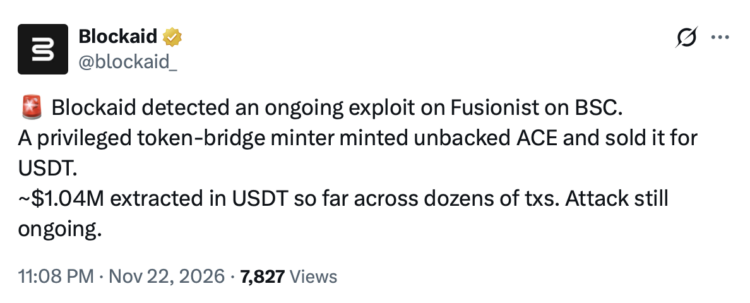
Security firm Blockaid flagged the Fusionist bridge-minter exploit on November 22. Its alert described the mechanism bluntly:

“

A privileged token-bridge minter minted unbacked ACE and sold it for USDT.

Blockaid · November 22 alert

The firm initially estimated that about $1.04 million had been extracted while the attack was still ongoing. That was an interim snapshot, not a cap on the damage.
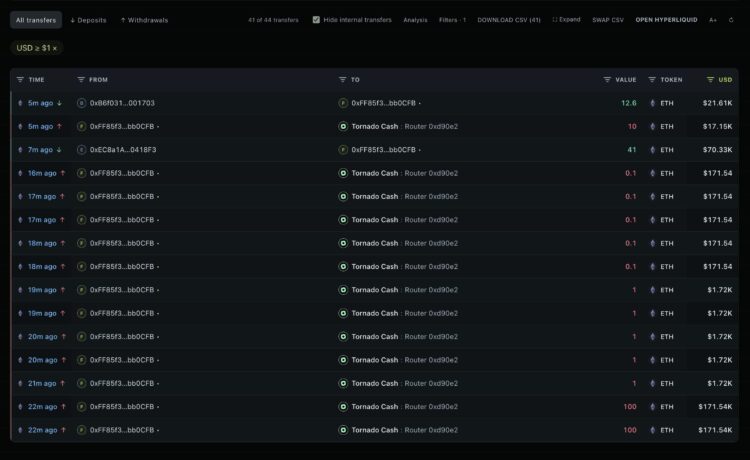
Blockchain-monitoring account Onchain Lens subsequently reported that an attacker had routed 1,091.5 ETH, valued at about $1.87 million at the time, through Tornado Cash. That observation traces a movement of proceeds, not an extra $1.87 million to add on top of the initial extraction estimate. The values describe different points in the same suspected attacker’s fund flow.
Fusionist acknowledged an apparent ongoing ACE exploit on BNB Smart Chain on Sunday and asked users to suspend transfers, trading and bridging on that network. It has not, in the material reviewed, provided a reconciled loss figure or a technical post-mortem identifying how the privileged minting authority was abused.

A bridge minter is supposed to create a token representation only when the corresponding value is properly accounted for. Once the right to mint is misused, a chain can show perfectly ordinary-looking balances that have no matching backing.

It is a familiar failure mode: NewsBTC previously covered a bridge-role exploit that minted unbacked tokens at CrediX. That earlier case does not establish Fusionist’s root cause, but it illustrates why elevated bridge permissions are such a consequential security boundary.

Traders Found a Second Exit Through Real ACE Reserves

The subsequent drain may prove more important than the initial minting spree.

According to SlowMist’s November 22 incident entry, traders bought the sharply discounted ACE created by the market disruption and used the cross-chain bridge to withdraw about 53.7 million genuine ACE from the Endurance-side reserves. SlowMist valued that withdrawal at approximately $3.7 million.

Here is the mechanism without the jargon. A representation of ACE on BNB Chain suddenly became cheap because unauthorized supply had flooded the market. A bridge that would still accept those tokens in exchange for ACE on Endurance offered an obvious difference in value.

Anyone able to complete that conversion could receive real tokens in return for deeply discounted ones. The trading opportunity existed because the backing and the circulating representation were no longer in a trustworthy relationship.

The $3.7 million figure is a valuation of the ACE reserve outflow, not proof that every recipient sold those tokens for $3.7 million in cash. Nor does it mean every trader involved helped compromise the minter.

There is a meaningful difference between initiating the security breach and trading through a system whose defenses have already failed.

Those distinctions should not obscure the core problem. A bridge can have technically valid transactions and still produce an economically disastrous result. If unbacked supply can be redeemed for genuine reserves, the checks have failed where they matter most.

Bithumb’s Monday Halt Shows How Far the Problem Travelled

Bithumb suspended ACE deposits and withdrawals early on November 23. It then halted trading effective 7:30 a.m. Korea time, according to its follow-up ACE security notice.

The exchange said, in a translation from its Korean announcement, that it had:

“

confirmed indications that abnormally issued ACE had entered cryptocurrency exchanges.

Bithumb · ACE security notice

It identified two related BNB Chain transactions and a second transaction.

Those records are important evidence leads, but a full independent decoding of the transaction trail remains outstanding.

Bithumb’s wording is careful: it reported signs of abnormal supply entering exchanges, not a finding that every ACE token in customer accounts is invalid. The trading suspension is a protective response, not a finalized determination of customer losses.

Still, it creates a practical problem for holders who never used the bridge. If tokens are fungible within a market, exchanges and the issuer need a credible method for identifying affected supply and deciding how deposits, balances and trades will be treated.

The Real Security Question Is Why the Bridge Could Honor the Claims

There is an understandable temptation to focus on the enormous minting figures. The more consequential question is what happened when those tokens met the bridge’s reserves.

A system does not need to lose control of its entire blockchain to suffer a serious failure in one privileged contract role. Nor should a successful-looking bridge transaction count as evidence that the asset being transferred was fully backed.

Our assessment

The response cannot end with a pause notice and a promise to investigate.

Fusionist needs to show which minting permissions were affected, whether they have been revoked, how much ACE was created without backing, how the Endurance-side reserve changed and what claims remain outstanding.

Exchanges need a defensible token-treatment plan, and holders need to know whether there is a shortfall and who is responsible for covering it.

There is a fair counterargument: the $5.7 million figure is an external estimate, market prices moved during the incident, and the precise compromise method is not established.

SlowMist categorizes the incident as private-key leakage, but that classification is not a substitute for an official technical finding. It would also be premature to treat a cautious exchange halt as proof that every affected customer suffered a loss.

Those qualifications change how the numbers should be reported. They do not make the underlying bridge-accounting failure less serious.

The next credible milestone is not a restored interface or a reassuring social post. It is a transparent reconciliation of the tokens minted, the reserves withdrawn and the assets still available to back legitimate ACE claims.

Until that exists, the estimated $5.7 million fallout remains a warning about both token security and the risks of trusting a bridge’s accounting.

Disclaimer: this article is for informational purposes only and is not financial advice.

Read Entire Article
Tags: CryptocurrencyInvestmentMining BitcoinNewsBTC
Share76Tweet47

Related Posts

Binance’s $6.5B court order gets served on the blockchain itself

Binance’s $6.5B court order gets served on the blockchain itself

by Jon Hartney
November 22, 2026
0

Binance obtained a $65 billion worldwide freezing order from ADGM Courts, with notices served on-chain to about 26,000 wallet addresses

Sonic audit finds S token supply 48% above announced 3.175 billion

Sonic audit finds S token supply 48% above announced 3.175 billion

by Jon Hartney
November 21, 2026
0

An independent audit found Sonic's S token supply is 470 billion, 48% above the 3175 billion announced at launch Sonic...

HTX Research Publishes Six-Month Outlook for Bitcoin and Crypto Markets

HTX Research Publishes Six-Month Outlook for Bitcoin and Crypto Markets

by Jon Hartney
November 20, 2026
0

Apia, Samoa, November 20, 2026 – HTX Research, the dedicated research arm of HTX, has published a new report titled...

As traditional giants rush into digital dollars, USDD’s Yvonne Chia explains why 24/7 access, self-custody, and transparent yield give decentralized stablecoins an edge banks can’t replicate. 20 November – Road Town, Totorla, British Virgin Islands – Decentralized stablecoin protocol USDD is accelerating its multichain utility across TRON, Ethereum, and BNB Chain—combining automated sUSDD yield via its Smart Allocator with GasFree zero-TRX transfers—as traditional financial giants race to build competing stablecoin rails.  In a recent industry interview with instant exchange partner ChangeNOW, USDD Head of Communications Yvonne Chia outlined why self-custody, 24/7 settlement, and transparent onchain reserves give decentralized digital dollars a structural advantage over bank-issued alternatives. 1. Permissionless Access vs. Gatekept Accounts For billions of people globally, opening and maintaining a traditional bank account still involves paperwork, minimum balance requirements, geographic restrictions, and approval delays. Even when banks integrate stablecoin rails behind the scenes, those services remain gated behind legacy compliance walls and intermediary control. Crypto-native stablecoins flip that model on its head. As Yvonne Chia highlighted during the interview: “Compare this to a stablecoin like USDD, where all you need is a phone, a working internet connection, you can immediately start a wallet and you have access to your funds right away.” With USDD, users can access and manage their digital dollars directly through their own wallets, without depending on traditional financial intermediaries.  This represents a fundamental shift in financial access: users are no longer limited to the services, operating hours, or account structures of a single institution. Instead, they have the freedom to hold, manage, and transfer their assets on their own terms. Self-custody also gives users greater autonomy over their financial decisions. They can choose which wallets to use, where to transfer their assets, and which supported decentralized applications to interact with, without needing to route every transaction through a centralized financial institution.  With USDD, users’ digital dollars can move with them across an open blockchain ecosystem, rather than remaining tied to a particular bank or service provider. 2. 24/7 Global Settlement vs. “Banking Hours” Legacy payment networks still operate on decades-old schedules: weekend cutoffs, bank holidays, and multi-day cross-border settlement delays accompanied by hefty wire fees. Blockchain networks never close. Whether it is a Sunday night or a public holiday, USDD moves globally without depending on traditional banking operating hours or settlement windows. “We are able to have transfers 24/7 and we’re not limited to any traditional banking hours. So I think that in some ways, stablecoins are not just becoming banks, but exceeding what traditional banks can offer to users.” To make everyday transfers even smoother than fintech apps, USDD introduced GasFree integration on TRON, allowing users on supported wallets to pay network fees directly in USDD without needing to hold TRX. This removes another practical barrier to stablecoin adoption: having to acquire and maintain a separate gas token just to transfer digital dollars. With GasFree, eligible users can pay approximately 0.5 USDD per transaction, compared with around 1.5 USDT for a standard USDT transfer under the referenced fee conditions. These improvements matter because the usefulness of a stablecoin is not determined by its peg alone. Low-cost transfers, straightforward wallet experiences, and around-the-clock availability are what make digital dollars practical for everyday payments and global value transfers. 3. Passing Yield Back to Users vs. Bank Spreads Perhaps the sharpest contrast between banks and decentralized stablecoins lies in how yield is distributed.  In traditional banking, institutions take customer deposits, deploy them into yield-generating markets, and retain a significant portion of the returns. Everyday depositors may receive relatively low interest rates, while higher-yielding products often come with eligibility requirements, minimum deposits, or fixed maturity periods. Stablecoins introduce another way to participate in digital-dollar opportunities. Rather than keeping capital entirely within a traditional deposit account, users can access onchain yield opportunities through decentralized protocols and transparent investment mechanisms. USDD was built to return that value directly to holders. Through USDD Earn, users can deposit USDD to receive sUSDD, earning automated, competitive yield powered by our Smart Allocator system, with no fixed lock-up periods restricting access to their capital. For users, the distinction is important: USDD Earn provides access to a productive stablecoin while maintaining flexibility, rather than requiring users to commit their capital to a conventional fixed-term product. 4. Onchain Verification vs. Institutional Trust Traditional banks ask customers to trust closed-door balance sheets and periodic regulatory filings—until a crisis proves otherwise.  USDD takes a different approach through its “Don’t trust, verify” ethos, emphasizing publicly accessible onchain information and independent verification. Onchain Transparency: Smart contract addresses, collateral reserves, and Smart Allocator deployments are publicly viewable, allowing users to examine relevant information directly on the blockchain. Structured Disclosures: Quarterly Treasury Reports provide additional information about reserve positions, financial performance, and operational developments. Independent Security Reviews: USDD undergoes third-party security audits to assess its smart contracts and identify potential vulnerabilities. Transparency does not eliminate financial or technical risks, but it changes how users can evaluate them. Instead of relying exclusively on an institution’s assurances, users have access to information that can be independently examined and verified. 5. Beyond a Single Network: An Open, Multichain Financial Ecosystem Financial freedom is not just about holding digital dollars. It is also about being able to use them wherever opportunities and applications exist. A stablecoin confined to a single network or limited use case cannot fully realize the potential of open blockchain finance. Following its January 2025 protocol upgrade, USDD expanded natively from TRON onto Ethereum and BNB Chain, extending its reach across multiple blockchain ecosystems. This multichain presence allows USDD to connect with different communities, liquidity environments, and decentralized applications. Its sUSDD product has also expanded into DeFi integrations, including Pendle and Morpho, giving users additional ways to access yield strategies across supported ecosystems. The bigger picture is an interconnected financial ecosystem in which users can move between holding, transferring, exchanging, and deploying their stablecoins according to their own needs. These are not isolated functions. Together, they make stablecoins more useful as everyday financial infrastructure. The Future: Interconnected, Open, and Multichain Banks will undoubtedly continue using stablecoin rails to modernize their back-end settlement. However, true financial freedom comes from open networks where assets flow freely across protocols without intermediaries. For USDD, the opportunity goes beyond offering a dollar-pegged asset. It is about making digital dollars accessible, transferable, and productive across an interconnected financial ecosystem. From self-custody and 24/7 transfers to flexible yield opportunities and multichain DeFi access, these capabilities give users more ways to put their money to work. Banks may be bringing stablecoins into traditional finance. Crypto-native protocols are showing what stablecoins can make possible beyond it.


As traditional giants rush into digital dollars, USDD’s Yvonne Chia explains why 24/7 access, self-custody, and transparent yield give decentralized stablecoins an edge banks can’t replicate. 20 November – Road Town, Totorla, British Virgin Islands – Decentralized stablecoin protocol USDD is accelerating its multichain utility across TRON, Ethereum, and BNB Chain—combining automated sUSDD yield via its Smart Allocator with GasFree zero-TRX transfers—as traditional financial giants race to build competing stablecoin rails. In a recent industry interview with instant exchange partner ChangeNOW, USDD Head of Communications Yvonne Chia outlined why self-custody, 24/7 settlement, and transparent onchain reserves give decentralized digital dollars a structural advantage over bank-issued alternatives. 1. Permissionless Access vs. Gatekept Accounts For billions of people globally, opening and maintaining a traditional bank account still involves paperwork, minimum balance requirements, geographic restrictions, and approval delays. Even when banks integrate stablecoin rails behind the scenes, those services remain gated behind legacy compliance walls and intermediary control. Crypto-native stablecoins flip that model on its head. As Yvonne Chia highlighted during the interview: “Compare this to a stablecoin like USDD, where all you need is a phone, a working internet connection, you can immediately start a wallet and you have access to your funds right away.” With USDD, users can access and manage their digital dollars directly through their own wallets, without depending on traditional financial intermediaries. This represents a fundamental shift in financial access: users are no longer limited to the services, operating hours, or account structures of a single institution. Instead, they have the freedom to hold, manage, and transfer their assets on their own terms. Self-custody also gives users greater autonomy over their financial decisions. They can choose which wallets to use, where to transfer their assets, and which supported decentralized applications to interact with, without needing to route every transaction through a centralized financial institution. With USDD, users’ digital dollars can move with them across an open blockchain ecosystem, rather than remaining tied to a particular bank or service provider. 2. 24/7 Global Settlement vs. “Banking Hours” Legacy payment networks still operate on decades-old schedules: weekend cutoffs, bank holidays, and multi-day cross-border settlement delays accompanied by hefty wire fees. Blockchain networks never close. Whether it is a Sunday night or a public holiday, USDD moves globally without depending on traditional banking operating hours or settlement windows. “We are able to have transfers 24/7 and we’re not limited to any traditional banking hours. So I think that in some ways, stablecoins are not just becoming banks, but exceeding what traditional banks can offer to users.” To make everyday transfers even smoother than fintech apps, USDD introduced GasFree integration on TRON, allowing users on supported wallets to pay network fees directly in USDD without needing to hold TRX. This removes another practical barrier to stablecoin adoption: having to acquire and maintain a separate gas token just to transfer digital dollars. With GasFree, eligible users can pay approximately 0.5 USDD per transaction, compared with around 1.5 USDT for a standard USDT transfer under the referenced fee conditions. These improvements matter because the usefulness of a stablecoin is not determined by its peg alone. Low-cost transfers, straightforward wallet experiences, and around-the-clock availability are what make digital dollars practical for everyday payments and global value transfers. 3. Passing Yield Back to Users vs. Bank Spreads Perhaps the sharpest contrast between banks and decentralized stablecoins lies in how yield is distributed. In traditional banking, institutions take customer deposits, deploy them into yield-generating markets, and retain a significant portion of the returns. Everyday depositors may receive relatively low interest rates, while higher-yielding products often come with eligibility requirements, minimum deposits, or fixed maturity periods. Stablecoins introduce another way to participate in digital-dollar opportunities. Rather than keeping capital entirely within a traditional deposit account, users can access onchain yield opportunities through decentralized protocols and transparent investment mechanisms. USDD was built to return that value directly to holders. Through USDD Earn, users can deposit USDD to receive sUSDD, earning automated, competitive yield powered by our Smart Allocator system, with no fixed lock-up periods restricting access to their capital. For users, the distinction is important: USDD Earn provides access to a productive stablecoin while maintaining flexibility, rather than requiring users to commit their capital to a conventional fixed-term product. 4. Onchain Verification vs. Institutional Trust Traditional banks ask customers to trust closed-door balance sheets and periodic regulatory filings—until a crisis proves otherwise. USDD takes a different approach through its “Don’t trust, verify” ethos, emphasizing publicly accessible onchain information and independent verification. Onchain Transparency: Smart contract addresses, collateral reserves, and Smart Allocator deployments are publicly viewable, allowing users to examine relevant information directly on the blockchain. Structured Disclosures: Quarterly Treasury Reports provide additional information about reserve positions, financial performance, and operational developments. Independent Security Reviews: USDD undergoes third-party security audits to assess its smart contracts and identify potential vulnerabilities. Transparency does not eliminate financial or technical risks, but it changes how users can evaluate them. Instead of relying exclusively on an institution’s assurances, users have access to information that can be independently examined and verified. 5. Beyond a Single Network: An Open, Multichain Financial Ecosystem Financial freedom is not just about holding digital dollars. It is also about being able to use them wherever opportunities and applications exist. A stablecoin confined to a single network or limited use case cannot fully realize the potential of open blockchain finance. Following its January 2025 protocol upgrade, USDD expanded natively from TRON onto Ethereum and BNB Chain, extending its reach across multiple blockchain ecosystems. This multichain presence allows USDD to connect with different communities, liquidity environments, and decentralized applications. Its sUSDD product has also expanded into DeFi integrations, including Pendle and Morpho, giving users additional ways to access yield strategies across supported ecosystems. The bigger picture is an interconnected financial ecosystem in which users can move between holding, transferring, exchanging, and deploying their stablecoins according to their own needs. These are not isolated functions. Together, they make stablecoins more useful as everyday financial infrastructure. The Future: Interconnected, Open, and Multichain Banks will undoubtedly continue using stablecoin rails to modernize their back-end settlement. However, true financial freedom comes from open networks where assets flow freely across protocols without intermediaries. For USDD, the opportunity goes beyond offering a dollar-pegged asset. It is about making digital dollars accessible, transferable, and productive across an interconnected financial ecosystem. From self-custody and 24/7 transfers to flexible yield opportunities and multichain DeFi access, these capabilities give users more ways to put their money to work. Banks may be bringing stablecoins into traditional finance. Crypto-native protocols are showing what stablecoins can make possible beyond it.

by Jon Hartney
November 20, 2026
0

As traditional giants rush into digital dollars, USDD’s Yvonne Chia explains why 24/7 access, self-custody, and transparent yield give decentralized...

Banks Are Adopting Stablecoins: Here Is Why Crypto-Native Dollars Still Win on User Freedom

Banks Are Adopting Stablecoins: Here Is Why Crypto-Native Dollars Still Win on User Freedom

by Jon Hartney
November 20, 2026
0

As traditional giants rush into digital dollars, USDD’s Yvonne Chia explains why 24/7 access, self-custody, and transparent yield give decentralized...

Load More
  • Trending
  • Comments
  • Latest
Crypto, Fintech push back against banks’ war on open banking

Crypto, Fintech push back against banks’ war on open banking

October 21, 2025
Bitcoin Cash (BCH) Pulls Back After Yesterday’s Big Push While Ecoterra Goes Up and Up

Bitcoin Cash (BCH) Pulls Back After Yesterday’s Big Push While Ecoterra Goes Up and Up

July 1, 2023
Bitcoin ETFs shed $1.2B in red week, but Schwab remains bullish

Bitcoin ETFs shed $1.2B in red week, but Schwab remains bullish

October 18, 2025
SUI Price Hits All-Time High – But Questions About Valuation Remain

SUI Price Hits All-Time High – But Questions About Valuation Remain

October 17, 2024
All aboard! Elon Musk’s Vegas Loop now taking Dogecoin payments

All aboard! Elon Musk’s Vegas Loop now taking Dogecoin payments

0
Crypto owners banned from working on US Government crypto policies

Crypto owners banned from working on US Government crypto policies

0
Korean startup Uprise lost $20M shorting LUNC

Korean startup Uprise lost $20M shorting LUNC

0
Ethereum testnet Merge mostly successful — ‘Hiccups will not delay the Merge.’

Ethereum testnet Merge mostly successful — ‘Hiccups will not delay the Merge.’

0
NFT Sales Fell +30% Last Week To $119M – InsideBitcoins

Fusionist ACE Bridge Exploit: $5.7M Loss Estimate, Bithumb Freezes Trading

November 23, 2026
Binance’s $6.5B court order gets served on the blockchain itself

Binance’s $6.5B court order gets served on the blockchain itself

November 22, 2026
Sonic audit finds S token supply 48% above announced 3.175 billion

Sonic audit finds S token supply 48% above announced 3.175 billion

November 21, 2026
HTX Research Publishes Six-Month Outlook for Bitcoin and Crypto Markets

HTX Research Publishes Six-Month Outlook for Bitcoin and Crypto Markets

November 20, 2026

XBT.Market

This website is an automated news feed powered by the Nebulome cloud system. The site is made possible by YYC TECH Consulting and Alberta Digital Mining Company. As a team with major crypto and bitcoin enthusiasm, we have curated major sources of news, trading and financial data to bring you, our viewer, an unbiased source of truth.

Recent Posts

  • Fusionist ACE Bridge Exploit: $5.7M Loss Estimate, Bithumb Freezes Trading November 23, 2026
  • Binance’s $6.5B court order gets served on the blockchain itself November 22, 2026
  • Sonic audit finds S token supply 48% above announced 3.175 billion November 21, 2026
  • HTX Research Publishes Six-Month Outlook for Bitcoin and Crypto Markets November 20, 2026
  • Banks Are Adopting Stablecoins: Here Is Why Crypto-Native Dollars Still Win on User Freedom November 20, 2026

News Categories

  • Bitcoin
  • Blockchain
  • Business
  • Market
  • Uncategorized

Tags

bitcoinMagzine Cointelegraph Cryptocurrency insidebitcoins Investment Mining Bitcoin NewsBTC

Quicklinks

  • Home
  • Coins MarketCap
  • Crypto Exchanges
  • Crypto Calculator
  • Top Gainers and Loser
  • News
  • Contact Us

© 2022 Xbt.Market - Powered by YYC Tech Consulting & ADMCO.

No Result
View All Result
  • Home
  • Coins MarketCap
  • Crypto Exchanges
  • Crypto Calculator
  • Top Gainers and Loser
  • News
  • Contact Us

© 2022 Xbt.Market by Nebulome.

  • Steakhouse EURCV Morpho VaultSteakhouse EURCV Morpho Vault(STEAKEURCV)$0.000000-100.00%
  • FibSwap DEXFibSwap DEX(FIBO)$0.0084659.90%
  • TruFin Staked APTTruFin Staked APT(TRUAPT)$8.020.00%
  • bitcoinBitcoin(BTC)$84,372.003.58%
  • ethereumEthereum(ETH)$1,885.365.68%
  • tetherTether(USDT)$1.000.00%
  • rippleXRP(XRP)$2.186.84%
  • USDEXUSDEX(USDEX)$1.07-0.53%
  • binancecoinBNB(BNB)$617.995.03%
  • Wrapped SOLWrapped SOL(SOL)$143.66-2.32%
  • solanaSolana(SOL)$128.974.23%
  • usd-coinUSDC(USDC)$1.000.01%
  • dogecoinDogecoin(DOGE)$0.1736117.78%
  • cardanoCardano(ADA)$0.687.61%
  • tronTRON(TRX)$0.2342340.79%
  • staked-etherLido Staked Ether(STETH)$1,884.065.48%
  • Gaj FinanceGaj Finance(GAJ)$0.0059271.46%
  • Content BitcoinContent Bitcoin(CTB)$24.482.55%
  • USD OneUSD One(USD1)$1.000.11%
  • wrapped-bitcoinWrapped Bitcoin(WBTC)$84,309.003.84%
  • ToncoinToncoin(TON)$4.157.66%
  • UGOLD Inc.UGOLD Inc.(UGOLD)$3,042.460.08%
  • ParkcoinParkcoin(KPK)$1.101.76%
  • chainlinkChainlink(LINK)$14.027.76%
  • leo-tokenLEO Token(LEO)$9.211.17%
  • stellarStellar(XLM)$0.2743585.70%
  • avalanche-2Avalanche(AVAX)$19.647.71%
  • Wrapped stETHWrapped stETH(WSTETH)$2,256.395.40%
  • USDSUSDS(USDS)$1.00-0.01%
  • SuiSui(SUI)$2.429.03%
  • shiba-inuShiba Inu(SHIB)$0.0000137.71%
  • hedera-hashgraphHedera(HBAR)$0.17284810.00%
  • Yay StakeStone EtherYay StakeStone Ether(YAYSTONE)$2,671.07-2.84%
  • polkadotPolkadot(DOT)$4.257.34%
  • litecoinLitecoin(LTC)$85.265.04%
  • bitcoin-cashBitcoin Cash(BCH)$314.248.23%
  • mantra-daoMANTRA(OM)$6.301.94%
  • Pundi AIFXPundi AIFX(PUNDIAI)$16.000.00%
  • PengPeng(PENG)$0.60-13.59%
  • Bitget TokenBitget Token(BGB)$4.664.95%
  • wethWETH(WETH)$1,884.285.66%
  • Ethena USDeEthena USDe(USDE)$1.00-0.04%
  • Binance Bridged USDT (BNB Smart Chain)Binance Bridged USDT (BNB Smart Chain)(BSC-USD)$1.00-0.18%
  • MurasakiMurasaki(MURA)$4.23-13.71%
  • Black PhoenixBlack Phoenix(BPX)$3.351,000.00%
  • Pi NetworkPi Network(PI)$0.714.53%
  • HyperliquidHyperliquid(HYPE)$13.729.80%
  • Wrapped eETHWrapped eETH(WEETH)$2,003.675.53%
  • WhiteBIT CoinWhiteBIT Coin(WBT)$28.350.76%
  • moneroMonero(XMR)$217.841.31%
  • Zypto TokenZypto Token(ZYPTO)$0.037139-3.47%
  • uniswapUniswap(UNI)$6.217.66%
  • AptosAptos(APT)$5.395.79%
  • PepePepe(PEPE)$0.00000811.37%
  • daiDai(DAI)$1.00-0.01%
  • nearNEAR Protocol(NEAR)$2.635.26%
  • XT.comXT.com(XT)$3.08-1.65%
  • Layer One XLayer One X(L1X)$23.35454.66%
  • sUSDSsUSDS(SUSDS)$1.050.05%
  • okbOKB(OKB)$48.762.12%
  • gatechain-tokenGate(GT)$22.883.58%
  • crypto-com-chainCronos(CRO)$0.1015853.46%
  • Coinbase Wrapped BTCCoinbase Wrapped BTC(CBBTC)$84,342.003.68%
  • MantleMantle(MNT)$0.814.44%
  • Tokenize XchangeTokenize Xchange(TKX)$33.460.86%
  • internet-computerInternet Computer(ICP)$5.517.85%
  • ethereum-classicEthereum Classic(ETC)$17.074.81%
  • OndoOndo(ONDO)$0.817.47%
  • First Digital USDFirst Digital USD(FDUSD)$1.00-0.12%
  • aaveAave(AAVE)$168.6110.19%
  • Aerarium FiAerarium Fi(AERA)$7.14-13.11%
  • Ethena Staked USDeEthena Staked USDe(SUSDE)$1.170.30%
  • BSCEXBSCEX(BSCX)$237.310.49%
  • Official TrumpOfficial Trump(TRUMP)$10.354.36%
  • vechainVeChain(VET)$0.0233636.04%
  • cosmosCosmos Hub(ATOM)$4.538.09%
  • fantomFantom(FTM)$0.70-1.56%
  • BittensorBittensor(TAO)$231.277.72%
  • BlackRock USD Institutional Digital Liquidity FundBlackRock USD Institutional Digital Liquidity Fund(BUIDL)$1.000.00%
  • EthenaEthena(ENA)$0.3616194.37%
  • render-tokenRender(RENDER)$3.6710.91%
  • filecoinFilecoin(FIL)$2.927.72%
  • CelestiaCelestia(TIA)$3.181.75%
  • Black AgnusBlack Agnus(FTW)$0.000183423.46%
  • Lombard Staked BTCLombard Staked BTC(LBTC)$84,465.004.02%
  • POL (ex-MATIC)POL (ex-MATIC)(POL)$0.2063993.13%
  • KaspaKaspa(KAS)$0.0682239.38%
  • STAUSTAU(STAU)$0.17397910.95%
  • FasttokenFasttoken(FTN)$4.020.01%
  • Sonic (prev. FTM)Sonic (prev. FTM)(S)$0.5212.98%
  • algorandAlgorand(ALGO)$0.1896979.65%
  • ORA CoinORA Coin(ORA)$4.885.92%
  • ArbitrumArbitrum(ARB)$0.3397526.22%
  • Arbitrum Bridged USDT (Arbitrum)Arbitrum Bridged USDT (Arbitrum)(USDT)$1.000.07%
  • GGTKNGGTKN(GGTKN)$0.1121180.75%
  • kucoin-sharesKuCoin(KCS)$11.231.19%
  • Solv Protocol SolvBTCSolv Protocol SolvBTC(SOLVBTC)$84,076.003.32%
  • fetch-aiArtificial Superintelligence Alliance(FET)$0.4856098.68%
  • optimismOptimism(OP)$0.776.43%
  • StoryStory(IP)$4.75-2.68%