• Market Cap: $2,418,160,157,835.35
  • 24h Vol: $108,433,118,919.67
  • BTC Dominance: 56.67%
XBT.Market
Advertisement
  • Home
  • Coins MarketCap
  • Crypto Exchanges
  • Crypto Calculator
  • Top Gainers and Loser
  • News
  • Contact Us
No Result
View All Result
XBT.Market
No Result
View All Result
Home Bitcoin

Saylor Reloads? Bitcoin Buy Signal Appears As BTC Nears $67K

Jon Hartney by Jon Hartney
March 10, 2026
in Bitcoin, Blockchain, Business, Market
0
Saylor Reloads? Bitcoin Buy Signal Appears As BTC Nears $67K
189
SHARES
1.5k
VIEWS
Share on FacebookShare on Twitter

Strategy, the company that has built its identity around hoarding Bitcoin, is now sitting on paper losses — and buying more anyway.

The company’s average purchase price sits at roughly $75,985 per coin, well above where Bitcoin is trading today at around $66,850.

Related articles

HTX Research Publishes Six-Month Outlook for Bitcoin and Crypto Markets

HTX Research Publishes Six-Month Outlook for Bitcoin and Crypto Markets

November 20, 2026
Banks Are Adopting Stablecoins: Here Is Why Crypto-Native Dollars Still Win on User Freedom

Banks Are Adopting Stablecoins: Here Is Why Crypto-Native Dollars Still Win on User Freedom

November 20, 2026

That gap has pushed Strategy’s net asset value below 1, meaning the stock is worth less than the Bitcoin it holds. It is a sharp reversal for a company that long commanded a premium over its own treasury.

Another Round Of Buying

Despite that, co-founder Michael Saylor posted the firm’s Bitcoin accumulation chart on X over the weekend with the message, “The Second Century Begins” — his recurring signal that another purchase is coming.

Strategy’s most recent buy came in the final week of February, when the company added 3,015 coins for more than $200 million, bringing its total haul to 720,737 Bitcoin. At current prices, that cache is worth roughly $48 billion.

The Second Century Begins. pic.twitter.com/stZzNhLgay

— Michael Saylor (@saylor) March 8, 2026
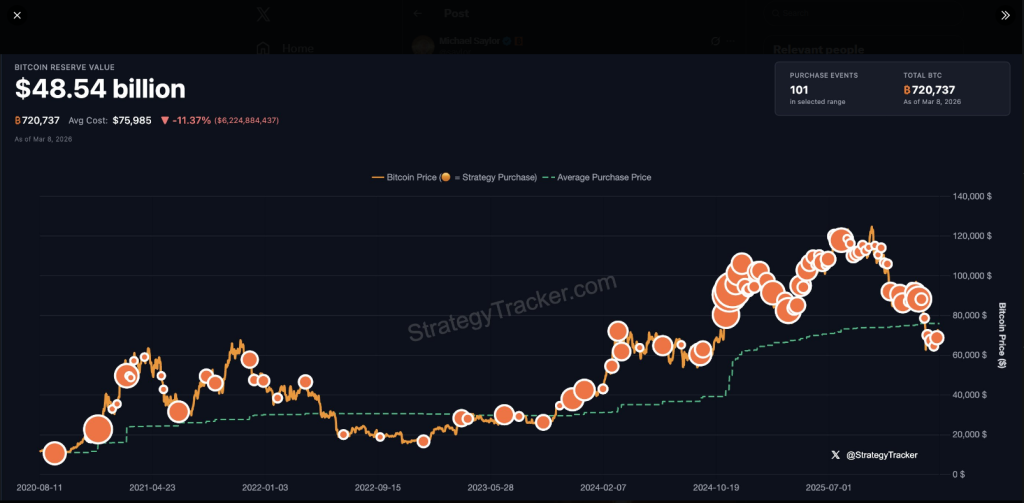
Debt And Equity Keep Fueling The Buys

The company has not paused its buying despite a broad market decline. Strategy continues to fund its purchases through debt and equity offerings — a model that works smoothly when Bitcoin is climbing, but draws harder scrutiny when prices fall.

With its NAV now below 1, some investors are getting Bitcoin exposure at a discount through the stock, which is a dynamic that rarely worked in Saylor’s favor before.

Data from SaylorTracker shows the depth of the current shortfall. The company’s unrealized loss grows wider with each dip in Bitcoin’s price, yet the firm shows no sign of changing course.

Saylor has made clear in past statements that Strategy is not a short-term trade but a long-duration bet on Bitcoin as a reserve asset.

Pressure Builds Across The Bitcoin Treasury Space

Strategy is not alone in feeling the squeeze. According to reports, the broader Bitcoin treasury sector could see consolidation in 2026, with cash-generating businesses moving to absorb companies that simply accumulate coins without producing revenue.

Wojciech Kaszycki, chief strategy officer at treasury firm BTCS, said companies trading below net asset value are under real pressure. Consolidating with another player, “sometimes two plus two equals six or more,” he said.

Saylor has brushed off that path. He said mergers and acquisitions take too long and carry too much uncertainty, noting that deals which look attractive at the start can look very different six to nine months later.

Whether another purchase is confirmed remains to be seen. But if history is any guide, the chart post rarely comes without a filing to follow.

Featured image from mybrokerone.com, chart from TradingView

Read Entire Article
Tags: CryptocurrencyInvestmentMining BitcoinNewsBTC
Share76Tweet47

Related Posts

HTX Research Publishes Six-Month Outlook for Bitcoin and Crypto Markets

HTX Research Publishes Six-Month Outlook for Bitcoin and Crypto Markets

by Jon Hartney
November 20, 2026
0

Apia, Samoa, November 20, 2026 – HTX Research, the dedicated research arm of HTX, has published a new report titled...

As traditional giants rush into digital dollars, USDD’s Yvonne Chia explains why 24/7 access, self-custody, and transparent yield give decentralized stablecoins an edge banks can’t replicate. 20 November – Road Town, Totorla, British Virgin Islands – Decentralized stablecoin protocol USDD is accelerating its multichain utility across TRON, Ethereum, and BNB Chain—combining automated sUSDD yield via its Smart Allocator with GasFree zero-TRX transfers—as traditional financial giants race to build competing stablecoin rails.  In a recent industry interview with instant exchange partner ChangeNOW, USDD Head of Communications Yvonne Chia outlined why self-custody, 24/7 settlement, and transparent onchain reserves give decentralized digital dollars a structural advantage over bank-issued alternatives. 1. Permissionless Access vs. Gatekept Accounts For billions of people globally, opening and maintaining a traditional bank account still involves paperwork, minimum balance requirements, geographic restrictions, and approval delays. Even when banks integrate stablecoin rails behind the scenes, those services remain gated behind legacy compliance walls and intermediary control. Crypto-native stablecoins flip that model on its head. As Yvonne Chia highlighted during the interview: “Compare this to a stablecoin like USDD, where all you need is a phone, a working internet connection, you can immediately start a wallet and you have access to your funds right away.” With USDD, users can access and manage their digital dollars directly through their own wallets, without depending on traditional financial intermediaries.  This represents a fundamental shift in financial access: users are no longer limited to the services, operating hours, or account structures of a single institution. Instead, they have the freedom to hold, manage, and transfer their assets on their own terms. Self-custody also gives users greater autonomy over their financial decisions. They can choose which wallets to use, where to transfer their assets, and which supported decentralized applications to interact with, without needing to route every transaction through a centralized financial institution.  With USDD, users’ digital dollars can move with them across an open blockchain ecosystem, rather than remaining tied to a particular bank or service provider. 2. 24/7 Global Settlement vs. “Banking Hours” Legacy payment networks still operate on decades-old schedules: weekend cutoffs, bank holidays, and multi-day cross-border settlement delays accompanied by hefty wire fees. Blockchain networks never close. Whether it is a Sunday night or a public holiday, USDD moves globally without depending on traditional banking operating hours or settlement windows. “We are able to have transfers 24/7 and we’re not limited to any traditional banking hours. So I think that in some ways, stablecoins are not just becoming banks, but exceeding what traditional banks can offer to users.” To make everyday transfers even smoother than fintech apps, USDD introduced GasFree integration on TRON, allowing users on supported wallets to pay network fees directly in USDD without needing to hold TRX. This removes another practical barrier to stablecoin adoption: having to acquire and maintain a separate gas token just to transfer digital dollars. With GasFree, eligible users can pay approximately 0.5 USDD per transaction, compared with around 1.5 USDT for a standard USDT transfer under the referenced fee conditions. These improvements matter because the usefulness of a stablecoin is not determined by its peg alone. Low-cost transfers, straightforward wallet experiences, and around-the-clock availability are what make digital dollars practical for everyday payments and global value transfers. 3. Passing Yield Back to Users vs. Bank Spreads Perhaps the sharpest contrast between banks and decentralized stablecoins lies in how yield is distributed.  In traditional banking, institutions take customer deposits, deploy them into yield-generating markets, and retain a significant portion of the returns. Everyday depositors may receive relatively low interest rates, while higher-yielding products often come with eligibility requirements, minimum deposits, or fixed maturity periods. Stablecoins introduce another way to participate in digital-dollar opportunities. Rather than keeping capital entirely within a traditional deposit account, users can access onchain yield opportunities through decentralized protocols and transparent investment mechanisms. USDD was built to return that value directly to holders. Through USDD Earn, users can deposit USDD to receive sUSDD, earning automated, competitive yield powered by our Smart Allocator system, with no fixed lock-up periods restricting access to their capital. For users, the distinction is important: USDD Earn provides access to a productive stablecoin while maintaining flexibility, rather than requiring users to commit their capital to a conventional fixed-term product. 4. Onchain Verification vs. Institutional Trust Traditional banks ask customers to trust closed-door balance sheets and periodic regulatory filings—until a crisis proves otherwise.  USDD takes a different approach through its “Don’t trust, verify” ethos, emphasizing publicly accessible onchain information and independent verification. Onchain Transparency: Smart contract addresses, collateral reserves, and Smart Allocator deployments are publicly viewable, allowing users to examine relevant information directly on the blockchain. Structured Disclosures: Quarterly Treasury Reports provide additional information about reserve positions, financial performance, and operational developments. Independent Security Reviews: USDD undergoes third-party security audits to assess its smart contracts and identify potential vulnerabilities. Transparency does not eliminate financial or technical risks, but it changes how users can evaluate them. Instead of relying exclusively on an institution’s assurances, users have access to information that can be independently examined and verified. 5. Beyond a Single Network: An Open, Multichain Financial Ecosystem Financial freedom is not just about holding digital dollars. It is also about being able to use them wherever opportunities and applications exist. A stablecoin confined to a single network or limited use case cannot fully realize the potential of open blockchain finance. Following its January 2025 protocol upgrade, USDD expanded natively from TRON onto Ethereum and BNB Chain, extending its reach across multiple blockchain ecosystems. This multichain presence allows USDD to connect with different communities, liquidity environments, and decentralized applications. Its sUSDD product has also expanded into DeFi integrations, including Pendle and Morpho, giving users additional ways to access yield strategies across supported ecosystems. The bigger picture is an interconnected financial ecosystem in which users can move between holding, transferring, exchanging, and deploying their stablecoins according to their own needs. These are not isolated functions. Together, they make stablecoins more useful as everyday financial infrastructure. The Future: Interconnected, Open, and Multichain Banks will undoubtedly continue using stablecoin rails to modernize their back-end settlement. However, true financial freedom comes from open networks where assets flow freely across protocols without intermediaries. For USDD, the opportunity goes beyond offering a dollar-pegged asset. It is about making digital dollars accessible, transferable, and productive across an interconnected financial ecosystem. From self-custody and 24/7 transfers to flexible yield opportunities and multichain DeFi access, these capabilities give users more ways to put their money to work. Banks may be bringing stablecoins into traditional finance. Crypto-native protocols are showing what stablecoins can make possible beyond it.

As traditional giants rush into digital dollars, USDD’s Yvonne Chia explains why 24/7 access, self-custody, and transparent yield give decentralized stablecoins an edge banks can’t replicate. 20 November – Road Town, Totorla, British Virgin Islands – Decentralized stablecoin protocol USDD is accelerating its multichain utility across TRON, Ethereum, and BNB Chain—combining automated sUSDD yield via its Smart Allocator with GasFree zero-TRX transfers—as traditional financial giants race to build competing stablecoin rails. In a recent industry interview with instant exchange partner ChangeNOW, USDD Head of Communications Yvonne Chia outlined why self-custody, 24/7 settlement, and transparent onchain reserves give decentralized digital dollars a structural advantage over bank-issued alternatives. 1. Permissionless Access vs. Gatekept Accounts For billions of people globally, opening and maintaining a traditional bank account still involves paperwork, minimum balance requirements, geographic restrictions, and approval delays. Even when banks integrate stablecoin rails behind the scenes, those services remain gated behind legacy compliance walls and intermediary control. Crypto-native stablecoins flip that model on its head. As Yvonne Chia highlighted during the interview: “Compare this to a stablecoin like USDD, where all you need is a phone, a working internet connection, you can immediately start a wallet and you have access to your funds right away.” With USDD, users can access and manage their digital dollars directly through their own wallets, without depending on traditional financial intermediaries. This represents a fundamental shift in financial access: users are no longer limited to the services, operating hours, or account structures of a single institution. Instead, they have the freedom to hold, manage, and transfer their assets on their own terms. Self-custody also gives users greater autonomy over their financial decisions. They can choose which wallets to use, where to transfer their assets, and which supported decentralized applications to interact with, without needing to route every transaction through a centralized financial institution. With USDD, users’ digital dollars can move with them across an open blockchain ecosystem, rather than remaining tied to a particular bank or service provider. 2. 24/7 Global Settlement vs. “Banking Hours” Legacy payment networks still operate on decades-old schedules: weekend cutoffs, bank holidays, and multi-day cross-border settlement delays accompanied by hefty wire fees. Blockchain networks never close. Whether it is a Sunday night or a public holiday, USDD moves globally without depending on traditional banking operating hours or settlement windows. “We are able to have transfers 24/7 and we’re not limited to any traditional banking hours. So I think that in some ways, stablecoins are not just becoming banks, but exceeding what traditional banks can offer to users.” To make everyday transfers even smoother than fintech apps, USDD introduced GasFree integration on TRON, allowing users on supported wallets to pay network fees directly in USDD without needing to hold TRX. This removes another practical barrier to stablecoin adoption: having to acquire and maintain a separate gas token just to transfer digital dollars. With GasFree, eligible users can pay approximately 0.5 USDD per transaction, compared with around 1.5 USDT for a standard USDT transfer under the referenced fee conditions. These improvements matter because the usefulness of a stablecoin is not determined by its peg alone. Low-cost transfers, straightforward wallet experiences, and around-the-clock availability are what make digital dollars practical for everyday payments and global value transfers. 3. Passing Yield Back to Users vs. Bank Spreads Perhaps the sharpest contrast between banks and decentralized stablecoins lies in how yield is distributed. In traditional banking, institutions take customer deposits, deploy them into yield-generating markets, and retain a significant portion of the returns. Everyday depositors may receive relatively low interest rates, while higher-yielding products often come with eligibility requirements, minimum deposits, or fixed maturity periods. Stablecoins introduce another way to participate in digital-dollar opportunities. Rather than keeping capital entirely within a traditional deposit account, users can access onchain yield opportunities through decentralized protocols and transparent investment mechanisms. USDD was built to return that value directly to holders. Through USDD Earn, users can deposit USDD to receive sUSDD, earning automated, competitive yield powered by our Smart Allocator system, with no fixed lock-up periods restricting access to their capital. For users, the distinction is important: USDD Earn provides access to a productive stablecoin while maintaining flexibility, rather than requiring users to commit their capital to a conventional fixed-term product. 4. Onchain Verification vs. Institutional Trust Traditional banks ask customers to trust closed-door balance sheets and periodic regulatory filings—until a crisis proves otherwise. USDD takes a different approach through its “Don’t trust, verify” ethos, emphasizing publicly accessible onchain information and independent verification. Onchain Transparency: Smart contract addresses, collateral reserves, and Smart Allocator deployments are publicly viewable, allowing users to examine relevant information directly on the blockchain. Structured Disclosures: Quarterly Treasury Reports provide additional information about reserve positions, financial performance, and operational developments. Independent Security Reviews: USDD undergoes third-party security audits to assess its smart contracts and identify potential vulnerabilities. Transparency does not eliminate financial or technical risks, but it changes how users can evaluate them. Instead of relying exclusively on an institution’s assurances, users have access to information that can be independently examined and verified. 5. Beyond a Single Network: An Open, Multichain Financial Ecosystem Financial freedom is not just about holding digital dollars. It is also about being able to use them wherever opportunities and applications exist. A stablecoin confined to a single network or limited use case cannot fully realize the potential of open blockchain finance. Following its January 2025 protocol upgrade, USDD expanded natively from TRON onto Ethereum and BNB Chain, extending its reach across multiple blockchain ecosystems. This multichain presence allows USDD to connect with different communities, liquidity environments, and decentralized applications. Its sUSDD product has also expanded into DeFi integrations, including Pendle and Morpho, giving users additional ways to access yield strategies across supported ecosystems. The bigger picture is an interconnected financial ecosystem in which users can move between holding, transferring, exchanging, and deploying their stablecoins according to their own needs. These are not isolated functions. Together, they make stablecoins more useful as everyday financial infrastructure. The Future: Interconnected, Open, and Multichain Banks will undoubtedly continue using stablecoin rails to modernize their back-end settlement. However, true financial freedom comes from open networks where assets flow freely across protocols without intermediaries. For USDD, the opportunity goes beyond offering a dollar-pegged asset. It is about making digital dollars accessible, transferable, and productive across an interconnected financial ecosystem. From self-custody and 24/7 transfers to flexible yield opportunities and multichain DeFi access, these capabilities give users more ways to put their money to work. Banks may be bringing stablecoins into traditional finance. Crypto-native protocols are showing what stablecoins can make possible beyond it.

by Jon Hartney
November 20, 2026
0

As traditional giants rush into digital dollars, USDD’s Yvonne Chia explains why 24/7 access, self-custody, and transparent yield give decentralized...

Banks Are Adopting Stablecoins: Here Is Why Crypto-Native Dollars Still Win on User Freedom

Banks Are Adopting Stablecoins: Here Is Why Crypto-Native Dollars Still Win on User Freedom

by Jon Hartney
November 20, 2026
0

As traditional giants rush into digital dollars, USDD’s Yvonne Chia explains why 24/7 access, self-custody, and transparent yield give decentralized...

IOSCO’s quantum warning names Ethereum and Solana, but not the network with the most exposed keys: bitcoin

IOSCO’s quantum warning names Ethereum and Solana, but not the network with the most exposed keys: bitcoin

by Jon Hartney
November 20, 2026
0

IOSCO's 63-page quantum-risk report names Ethereum, Solana and Tron as examples and never mentions bitcoin, where an estimated 693 million...

BingX Adds Anthropic Spot and Perpetual Futures Trading Following Nasdaq Debut

BingX Adds Anthropic Spot and Perpetual Futures Trading Following Nasdaq Debut

by Jon Hartney
November 19, 2026
0

PANAMA CITY, November 19, 2026 – BingX, the world’s leading multi-asset trading platform, today announced that Anthropic (Nasdaq: ANT) is...

Load More
  • Trending
  • Comments
  • Latest
Crypto, Fintech push back against banks’ war on open banking

Crypto, Fintech push back against banks’ war on open banking

October 21, 2025
Bitcoin Cash (BCH) Pulls Back After Yesterday’s Big Push While Ecoterra Goes Up and Up

Bitcoin Cash (BCH) Pulls Back After Yesterday’s Big Push While Ecoterra Goes Up and Up

July 1, 2023
Bitcoin ETFs shed $1.2B in red week, but Schwab remains bullish

Bitcoin ETFs shed $1.2B in red week, but Schwab remains bullish

October 18, 2025
SUI Price Hits All-Time High – But Questions About Valuation Remain

SUI Price Hits All-Time High – But Questions About Valuation Remain

October 17, 2024
All aboard! Elon Musk’s Vegas Loop now taking Dogecoin payments

All aboard! Elon Musk’s Vegas Loop now taking Dogecoin payments

0
Crypto owners banned from working on US Government crypto policies

Crypto owners banned from working on US Government crypto policies

0
Korean startup Uprise lost $20M shorting LUNC

Korean startup Uprise lost $20M shorting LUNC

0
Ethereum testnet Merge mostly successful — ‘Hiccups will not delay the Merge.’

Ethereum testnet Merge mostly successful — ‘Hiccups will not delay the Merge.’

0
HTX Research Publishes Six-Month Outlook for Bitcoin and Crypto Markets

HTX Research Publishes Six-Month Outlook for Bitcoin and Crypto Markets

November 20, 2026
Banks Are Adopting Stablecoins: Here Is Why Crypto-Native Dollars Still Win on User Freedom

Banks Are Adopting Stablecoins: Here Is Why Crypto-Native Dollars Still Win on User Freedom

November 20, 2026
As traditional giants rush into digital dollars, USDD’s Yvonne Chia explains why 24/7 access, self-custody, and transparent yield give decentralized stablecoins an edge banks can’t replicate. 20 November – Road Town, Totorla, British Virgin Islands – Decentralized stablecoin protocol USDD is accelerating its multichain utility across TRON, Ethereum, and BNB Chain—combining automated sUSDD yield via its Smart Allocator with GasFree zero-TRX transfers—as traditional financial giants race to build competing stablecoin rails.  In a recent industry interview with instant exchange partner ChangeNOW, USDD Head of Communications Yvonne Chia outlined why self-custody, 24/7 settlement, and transparent onchain reserves give decentralized digital dollars a structural advantage over bank-issued alternatives. 1. Permissionless Access vs. Gatekept Accounts For billions of people globally, opening and maintaining a traditional bank account still involves paperwork, minimum balance requirements, geographic restrictions, and approval delays. Even when banks integrate stablecoin rails behind the scenes, those services remain gated behind legacy compliance walls and intermediary control. Crypto-native stablecoins flip that model on its head. As Yvonne Chia highlighted during the interview: “Compare this to a stablecoin like USDD, where all you need is a phone, a working internet connection, you can immediately start a wallet and you have access to your funds right away.” With USDD, users can access and manage their digital dollars directly through their own wallets, without depending on traditional financial intermediaries.  This represents a fundamental shift in financial access: users are no longer limited to the services, operating hours, or account structures of a single institution. Instead, they have the freedom to hold, manage, and transfer their assets on their own terms. Self-custody also gives users greater autonomy over their financial decisions. They can choose which wallets to use, where to transfer their assets, and which supported decentralized applications to interact with, without needing to route every transaction through a centralized financial institution.  With USDD, users’ digital dollars can move with them across an open blockchain ecosystem, rather than remaining tied to a particular bank or service provider. 2. 24/7 Global Settlement vs. “Banking Hours” Legacy payment networks still operate on decades-old schedules: weekend cutoffs, bank holidays, and multi-day cross-border settlement delays accompanied by hefty wire fees. Blockchain networks never close. Whether it is a Sunday night or a public holiday, USDD moves globally without depending on traditional banking operating hours or settlement windows. “We are able to have transfers 24/7 and we’re not limited to any traditional banking hours. So I think that in some ways, stablecoins are not just becoming banks, but exceeding what traditional banks can offer to users.” To make everyday transfers even smoother than fintech apps, USDD introduced GasFree integration on TRON, allowing users on supported wallets to pay network fees directly in USDD without needing to hold TRX. This removes another practical barrier to stablecoin adoption: having to acquire and maintain a separate gas token just to transfer digital dollars. With GasFree, eligible users can pay approximately 0.5 USDD per transaction, compared with around 1.5 USDT for a standard USDT transfer under the referenced fee conditions. These improvements matter because the usefulness of a stablecoin is not determined by its peg alone. Low-cost transfers, straightforward wallet experiences, and around-the-clock availability are what make digital dollars practical for everyday payments and global value transfers. 3. Passing Yield Back to Users vs. Bank Spreads Perhaps the sharpest contrast between banks and decentralized stablecoins lies in how yield is distributed.  In traditional banking, institutions take customer deposits, deploy them into yield-generating markets, and retain a significant portion of the returns. Everyday depositors may receive relatively low interest rates, while higher-yielding products often come with eligibility requirements, minimum deposits, or fixed maturity periods. Stablecoins introduce another way to participate in digital-dollar opportunities. Rather than keeping capital entirely within a traditional deposit account, users can access onchain yield opportunities through decentralized protocols and transparent investment mechanisms. USDD was built to return that value directly to holders. Through USDD Earn, users can deposit USDD to receive sUSDD, earning automated, competitive yield powered by our Smart Allocator system, with no fixed lock-up periods restricting access to their capital. For users, the distinction is important: USDD Earn provides access to a productive stablecoin while maintaining flexibility, rather than requiring users to commit their capital to a conventional fixed-term product. 4. Onchain Verification vs. Institutional Trust Traditional banks ask customers to trust closed-door balance sheets and periodic regulatory filings—until a crisis proves otherwise.  USDD takes a different approach through its “Don’t trust, verify” ethos, emphasizing publicly accessible onchain information and independent verification. Onchain Transparency: Smart contract addresses, collateral reserves, and Smart Allocator deployments are publicly viewable, allowing users to examine relevant information directly on the blockchain. Structured Disclosures: Quarterly Treasury Reports provide additional information about reserve positions, financial performance, and operational developments. Independent Security Reviews: USDD undergoes third-party security audits to assess its smart contracts and identify potential vulnerabilities. Transparency does not eliminate financial or technical risks, but it changes how users can evaluate them. Instead of relying exclusively on an institution’s assurances, users have access to information that can be independently examined and verified. 5. Beyond a Single Network: An Open, Multichain Financial Ecosystem Financial freedom is not just about holding digital dollars. It is also about being able to use them wherever opportunities and applications exist. A stablecoin confined to a single network or limited use case cannot fully realize the potential of open blockchain finance. Following its January 2025 protocol upgrade, USDD expanded natively from TRON onto Ethereum and BNB Chain, extending its reach across multiple blockchain ecosystems. This multichain presence allows USDD to connect with different communities, liquidity environments, and decentralized applications. Its sUSDD product has also expanded into DeFi integrations, including Pendle and Morpho, giving users additional ways to access yield strategies across supported ecosystems. The bigger picture is an interconnected financial ecosystem in which users can move between holding, transferring, exchanging, and deploying their stablecoins according to their own needs. These are not isolated functions. Together, they make stablecoins more useful as everyday financial infrastructure. The Future: Interconnected, Open, and Multichain Banks will undoubtedly continue using stablecoin rails to modernize their back-end settlement. However, true financial freedom comes from open networks where assets flow freely across protocols without intermediaries. For USDD, the opportunity goes beyond offering a dollar-pegged asset. It is about making digital dollars accessible, transferable, and productive across an interconnected financial ecosystem. From self-custody and 24/7 transfers to flexible yield opportunities and multichain DeFi access, these capabilities give users more ways to put their money to work. Banks may be bringing stablecoins into traditional finance. Crypto-native protocols are showing what stablecoins can make possible beyond it.

As traditional giants rush into digital dollars, USDD’s Yvonne Chia explains why 24/7 access, self-custody, and transparent yield give decentralized stablecoins an edge banks can’t replicate. 20 November – Road Town, Totorla, British Virgin Islands – Decentralized stablecoin protocol USDD is accelerating its multichain utility across TRON, Ethereum, and BNB Chain—combining automated sUSDD yield via its Smart Allocator with GasFree zero-TRX transfers—as traditional financial giants race to build competing stablecoin rails. In a recent industry interview with instant exchange partner ChangeNOW, USDD Head of Communications Yvonne Chia outlined why self-custody, 24/7 settlement, and transparent onchain reserves give decentralized digital dollars a structural advantage over bank-issued alternatives. 1. Permissionless Access vs. Gatekept Accounts For billions of people globally, opening and maintaining a traditional bank account still involves paperwork, minimum balance requirements, geographic restrictions, and approval delays. Even when banks integrate stablecoin rails behind the scenes, those services remain gated behind legacy compliance walls and intermediary control. Crypto-native stablecoins flip that model on its head. As Yvonne Chia highlighted during the interview: “Compare this to a stablecoin like USDD, where all you need is a phone, a working internet connection, you can immediately start a wallet and you have access to your funds right away.” With USDD, users can access and manage their digital dollars directly through their own wallets, without depending on traditional financial intermediaries. This represents a fundamental shift in financial access: users are no longer limited to the services, operating hours, or account structures of a single institution. Instead, they have the freedom to hold, manage, and transfer their assets on their own terms. Self-custody also gives users greater autonomy over their financial decisions. They can choose which wallets to use, where to transfer their assets, and which supported decentralized applications to interact with, without needing to route every transaction through a centralized financial institution. With USDD, users’ digital dollars can move with them across an open blockchain ecosystem, rather than remaining tied to a particular bank or service provider. 2. 24/7 Global Settlement vs. “Banking Hours” Legacy payment networks still operate on decades-old schedules: weekend cutoffs, bank holidays, and multi-day cross-border settlement delays accompanied by hefty wire fees. Blockchain networks never close. Whether it is a Sunday night or a public holiday, USDD moves globally without depending on traditional banking operating hours or settlement windows. “We are able to have transfers 24/7 and we’re not limited to any traditional banking hours. So I think that in some ways, stablecoins are not just becoming banks, but exceeding what traditional banks can offer to users.” To make everyday transfers even smoother than fintech apps, USDD introduced GasFree integration on TRON, allowing users on supported wallets to pay network fees directly in USDD without needing to hold TRX. This removes another practical barrier to stablecoin adoption: having to acquire and maintain a separate gas token just to transfer digital dollars. With GasFree, eligible users can pay approximately 0.5 USDD per transaction, compared with around 1.5 USDT for a standard USDT transfer under the referenced fee conditions. These improvements matter because the usefulness of a stablecoin is not determined by its peg alone. Low-cost transfers, straightforward wallet experiences, and around-the-clock availability are what make digital dollars practical for everyday payments and global value transfers. 3. Passing Yield Back to Users vs. Bank Spreads Perhaps the sharpest contrast between banks and decentralized stablecoins lies in how yield is distributed. In traditional banking, institutions take customer deposits, deploy them into yield-generating markets, and retain a significant portion of the returns. Everyday depositors may receive relatively low interest rates, while higher-yielding products often come with eligibility requirements, minimum deposits, or fixed maturity periods. Stablecoins introduce another way to participate in digital-dollar opportunities. Rather than keeping capital entirely within a traditional deposit account, users can access onchain yield opportunities through decentralized protocols and transparent investment mechanisms. USDD was built to return that value directly to holders. Through USDD Earn, users can deposit USDD to receive sUSDD, earning automated, competitive yield powered by our Smart Allocator system, with no fixed lock-up periods restricting access to their capital. For users, the distinction is important: USDD Earn provides access to a productive stablecoin while maintaining flexibility, rather than requiring users to commit their capital to a conventional fixed-term product. 4. Onchain Verification vs. Institutional Trust Traditional banks ask customers to trust closed-door balance sheets and periodic regulatory filings—until a crisis proves otherwise. USDD takes a different approach through its “Don’t trust, verify” ethos, emphasizing publicly accessible onchain information and independent verification. Onchain Transparency: Smart contract addresses, collateral reserves, and Smart Allocator deployments are publicly viewable, allowing users to examine relevant information directly on the blockchain. Structured Disclosures: Quarterly Treasury Reports provide additional information about reserve positions, financial performance, and operational developments. Independent Security Reviews: USDD undergoes third-party security audits to assess its smart contracts and identify potential vulnerabilities. Transparency does not eliminate financial or technical risks, but it changes how users can evaluate them. Instead of relying exclusively on an institution’s assurances, users have access to information that can be independently examined and verified. 5. Beyond a Single Network: An Open, Multichain Financial Ecosystem Financial freedom is not just about holding digital dollars. It is also about being able to use them wherever opportunities and applications exist. A stablecoin confined to a single network or limited use case cannot fully realize the potential of open blockchain finance. Following its January 2025 protocol upgrade, USDD expanded natively from TRON onto Ethereum and BNB Chain, extending its reach across multiple blockchain ecosystems. This multichain presence allows USDD to connect with different communities, liquidity environments, and decentralized applications. Its sUSDD product has also expanded into DeFi integrations, including Pendle and Morpho, giving users additional ways to access yield strategies across supported ecosystems. The bigger picture is an interconnected financial ecosystem in which users can move between holding, transferring, exchanging, and deploying their stablecoins according to their own needs. These are not isolated functions. Together, they make stablecoins more useful as everyday financial infrastructure. The Future: Interconnected, Open, and Multichain Banks will undoubtedly continue using stablecoin rails to modernize their back-end settlement. However, true financial freedom comes from open networks where assets flow freely across protocols without intermediaries. For USDD, the opportunity goes beyond offering a dollar-pegged asset. It is about making digital dollars accessible, transferable, and productive across an interconnected financial ecosystem. From self-custody and 24/7 transfers to flexible yield opportunities and multichain DeFi access, these capabilities give users more ways to put their money to work. Banks may be bringing stablecoins into traditional finance. Crypto-native protocols are showing what stablecoins can make possible beyond it.

November 20, 2026
IOSCO’s quantum warning names Ethereum and Solana, but not the network with the most exposed keys: bitcoin

IOSCO’s quantum warning names Ethereum and Solana, but not the network with the most exposed keys: bitcoin

November 20, 2026

XBT.Market

This website is an automated news feed powered by the Nebulome cloud system. The site is made possible by YYC TECH Consulting and Alberta Digital Mining Company. As a team with major crypto and bitcoin enthusiasm, we have curated major sources of news, trading and financial data to bring you, our viewer, an unbiased source of truth.

Recent Posts

  • HTX Research Publishes Six-Month Outlook for Bitcoin and Crypto Markets November 20, 2026
  • Banks Are Adopting Stablecoins: Here Is Why Crypto-Native Dollars Still Win on User Freedom November 20, 2026
  • As traditional giants rush into digital dollars, USDD’s Yvonne Chia explains why 24/7 access, self-custody, and transparent yield give decentralized stablecoins an edge banks can’t replicate. 20 November – Road Town, Totorla, British Virgin Islands – Decentralized stablecoin protocol USDD is accelerating its multichain utility across TRON, Ethereum, and BNB Chain—combining automated sUSDD yield via its Smart Allocator with GasFree zero-TRX transfers—as traditional financial giants race to build competing stablecoin rails. In a recent industry interview with instant exchange partner ChangeNOW, USDD Head of Communications Yvonne Chia outlined why self-custody, 24/7 settlement, and transparent onchain reserves give decentralized digital dollars a structural advantage over bank-issued alternatives. 1. Permissionless Access vs. Gatekept Accounts For billions of people globally, opening and maintaining a traditional bank account still involves paperwork, minimum balance requirements, geographic restrictions, and approval delays. Even when banks integrate stablecoin rails behind the scenes, those services remain gated behind legacy compliance walls and intermediary control. Crypto-native stablecoins flip that model on its head. As Yvonne Chia highlighted during the interview: “Compare this to a stablecoin like USDD, where all you need is a phone, a working internet connection, you can immediately start a wallet and you have access to your funds right away.” With USDD, users can access and manage their digital dollars directly through their own wallets, without depending on traditional financial intermediaries. This represents a fundamental shift in financial access: users are no longer limited to the services, operating hours, or account structures of a single institution. Instead, they have the freedom to hold, manage, and transfer their assets on their own terms. Self-custody also gives users greater autonomy over their financial decisions. They can choose which wallets to use, where to transfer their assets, and which supported decentralized applications to interact with, without needing to route every transaction through a centralized financial institution. With USDD, users’ digital dollars can move with them across an open blockchain ecosystem, rather than remaining tied to a particular bank or service provider. 2. 24/7 Global Settlement vs. “Banking Hours” Legacy payment networks still operate on decades-old schedules: weekend cutoffs, bank holidays, and multi-day cross-border settlement delays accompanied by hefty wire fees. Blockchain networks never close. Whether it is a Sunday night or a public holiday, USDD moves globally without depending on traditional banking operating hours or settlement windows. “We are able to have transfers 24/7 and we’re not limited to any traditional banking hours. So I think that in some ways, stablecoins are not just becoming banks, but exceeding what traditional banks can offer to users.” To make everyday transfers even smoother than fintech apps, USDD introduced GasFree integration on TRON, allowing users on supported wallets to pay network fees directly in USDD without needing to hold TRX. This removes another practical barrier to stablecoin adoption: having to acquire and maintain a separate gas token just to transfer digital dollars. With GasFree, eligible users can pay approximately 0.5 USDD per transaction, compared with around 1.5 USDT for a standard USDT transfer under the referenced fee conditions. These improvements matter because the usefulness of a stablecoin is not determined by its peg alone. Low-cost transfers, straightforward wallet experiences, and around-the-clock availability are what make digital dollars practical for everyday payments and global value transfers. 3. Passing Yield Back to Users vs. Bank Spreads Perhaps the sharpest contrast between banks and decentralized stablecoins lies in how yield is distributed. In traditional banking, institutions take customer deposits, deploy them into yield-generating markets, and retain a significant portion of the returns. Everyday depositors may receive relatively low interest rates, while higher-yielding products often come with eligibility requirements, minimum deposits, or fixed maturity periods. Stablecoins introduce another way to participate in digital-dollar opportunities. Rather than keeping capital entirely within a traditional deposit account, users can access onchain yield opportunities through decentralized protocols and transparent investment mechanisms. USDD was built to return that value directly to holders. Through USDD Earn, users can deposit USDD to receive sUSDD, earning automated, competitive yield powered by our Smart Allocator system, with no fixed lock-up periods restricting access to their capital. For users, the distinction is important: USDD Earn provides access to a productive stablecoin while maintaining flexibility, rather than requiring users to commit their capital to a conventional fixed-term product. 4. Onchain Verification vs. Institutional Trust Traditional banks ask customers to trust closed-door balance sheets and periodic regulatory filings—until a crisis proves otherwise. USDD takes a different approach through its “Don’t trust, verify” ethos, emphasizing publicly accessible onchain information and independent verification. Onchain Transparency: Smart contract addresses, collateral reserves, and Smart Allocator deployments are publicly viewable, allowing users to examine relevant information directly on the blockchain. Structured Disclosures: Quarterly Treasury Reports provide additional information about reserve positions, financial performance, and operational developments. Independent Security Reviews: USDD undergoes third-party security audits to assess its smart contracts and identify potential vulnerabilities. Transparency does not eliminate financial or technical risks, but it changes how users can evaluate them. Instead of relying exclusively on an institution’s assurances, users have access to information that can be independently examined and verified. 5. Beyond a Single Network: An Open, Multichain Financial Ecosystem Financial freedom is not just about holding digital dollars. It is also about being able to use them wherever opportunities and applications exist. A stablecoin confined to a single network or limited use case cannot fully realize the potential of open blockchain finance. Following its January 2025 protocol upgrade, USDD expanded natively from TRON onto Ethereum and BNB Chain, extending its reach across multiple blockchain ecosystems. This multichain presence allows USDD to connect with different communities, liquidity environments, and decentralized applications. Its sUSDD product has also expanded into DeFi integrations, including Pendle and Morpho, giving users additional ways to access yield strategies across supported ecosystems. The bigger picture is an interconnected financial ecosystem in which users can move between holding, transferring, exchanging, and deploying their stablecoins according to their own needs. These are not isolated functions. Together, they make stablecoins more useful as everyday financial infrastructure. The Future: Interconnected, Open, and Multichain Banks will undoubtedly continue using stablecoin rails to modernize their back-end settlement. However, true financial freedom comes from open networks where assets flow freely across protocols without intermediaries. For USDD, the opportunity goes beyond offering a dollar-pegged asset. It is about making digital dollars accessible, transferable, and productive across an interconnected financial ecosystem. From self-custody and 24/7 transfers to flexible yield opportunities and multichain DeFi access, these capabilities give users more ways to put their money to work. Banks may be bringing stablecoins into traditional finance. Crypto-native protocols are showing what stablecoins can make possible beyond it. November 20, 2026
  • IOSCO’s quantum warning names Ethereum and Solana, but not the network with the most exposed keys: bitcoin November 20, 2026
  • BingX Adds Anthropic Spot and Perpetual Futures Trading Following Nasdaq Debut November 19, 2026

News Categories

  • Bitcoin
  • Blockchain
  • Business
  • Market
  • Uncategorized

Tags

bitcoinMagzine Cointelegraph Cryptocurrency insidebitcoins Investment Mining Bitcoin NewsBTC

Quicklinks

  • Home
  • Coins MarketCap
  • Crypto Exchanges
  • Crypto Calculator
  • Top Gainers and Loser
  • News
  • Contact Us

© 2022 Xbt.Market - Powered by YYC Tech Consulting & ADMCO.

No Result
View All Result
  • Home
  • Coins MarketCap
  • Crypto Exchanges
  • Crypto Calculator
  • Top Gainers and Loser
  • News
  • Contact Us

© 2022 Xbt.Market by Nebulome.

  • Steakhouse EURCV Morpho VaultSteakhouse EURCV Morpho Vault(STEAKEURCV)$0.000000-100.00%
  • FibSwap DEXFibSwap DEX(FIBO)$0.0084659.90%
  • TruFin Staked APTTruFin Staked APT(TRUAPT)$8.020.00%
  • bitcoinBitcoin(BTC)$84,372.003.58%
  • ethereumEthereum(ETH)$1,885.365.68%
  • tetherTether(USDT)$1.000.00%
  • rippleXRP(XRP)$2.186.84%
  • USDEXUSDEX(USDEX)$1.07-0.53%
  • binancecoinBNB(BNB)$617.995.03%
  • Wrapped SOLWrapped SOL(SOL)$143.66-2.32%
  • solanaSolana(SOL)$128.974.23%
  • usd-coinUSDC(USDC)$1.000.01%
  • dogecoinDogecoin(DOGE)$0.1736117.78%
  • cardanoCardano(ADA)$0.687.61%
  • tronTRON(TRX)$0.2342340.79%
  • staked-etherLido Staked Ether(STETH)$1,884.065.48%
  • Gaj FinanceGaj Finance(GAJ)$0.0059271.46%
  • Content BitcoinContent Bitcoin(CTB)$24.482.55%
  • USD OneUSD One(USD1)$1.000.11%
  • wrapped-bitcoinWrapped Bitcoin(WBTC)$84,309.003.84%
  • ToncoinToncoin(TON)$4.157.66%
  • UGOLD Inc.UGOLD Inc.(UGOLD)$3,042.460.08%
  • ParkcoinParkcoin(KPK)$1.101.76%
  • chainlinkChainlink(LINK)$14.027.76%
  • leo-tokenLEO Token(LEO)$9.211.17%
  • stellarStellar(XLM)$0.2743585.70%
  • avalanche-2Avalanche(AVAX)$19.647.71%
  • Wrapped stETHWrapped stETH(WSTETH)$2,256.395.40%
  • USDSUSDS(USDS)$1.00-0.01%
  • SuiSui(SUI)$2.429.03%
  • shiba-inuShiba Inu(SHIB)$0.0000137.71%
  • hedera-hashgraphHedera(HBAR)$0.17284810.00%
  • Yay StakeStone EtherYay StakeStone Ether(YAYSTONE)$2,671.07-2.84%
  • polkadotPolkadot(DOT)$4.257.34%
  • litecoinLitecoin(LTC)$85.265.04%
  • bitcoin-cashBitcoin Cash(BCH)$314.248.23%
  • mantra-daoMANTRA(OM)$6.301.94%
  • Pundi AIFXPundi AIFX(PUNDIAI)$16.000.00%
  • PengPeng(PENG)$0.60-13.59%
  • Bitget TokenBitget Token(BGB)$4.664.95%
  • wethWETH(WETH)$1,884.285.66%
  • Ethena USDeEthena USDe(USDE)$1.00-0.04%
  • Binance Bridged USDT (BNB Smart Chain)Binance Bridged USDT (BNB Smart Chain)(BSC-USD)$1.00-0.18%
  • MurasakiMurasaki(MURA)$4.23-13.71%
  • Black PhoenixBlack Phoenix(BPX)$3.351,000.00%
  • Pi NetworkPi Network(PI)$0.714.53%
  • HyperliquidHyperliquid(HYPE)$13.729.80%
  • Wrapped eETHWrapped eETH(WEETH)$2,003.675.53%
  • WhiteBIT CoinWhiteBIT Coin(WBT)$28.350.76%
  • moneroMonero(XMR)$217.841.31%
  • Zypto TokenZypto Token(ZYPTO)$0.037139-3.47%
  • uniswapUniswap(UNI)$6.217.66%
  • AptosAptos(APT)$5.395.79%
  • PepePepe(PEPE)$0.00000811.37%
  • daiDai(DAI)$1.00-0.01%
  • nearNEAR Protocol(NEAR)$2.635.26%
  • XT.comXT.com(XT)$3.08-1.65%
  • Layer One XLayer One X(L1X)$23.35454.66%
  • sUSDSsUSDS(SUSDS)$1.050.05%
  • okbOKB(OKB)$48.762.12%
  • gatechain-tokenGate(GT)$22.883.58%
  • crypto-com-chainCronos(CRO)$0.1015853.46%
  • Coinbase Wrapped BTCCoinbase Wrapped BTC(CBBTC)$84,342.003.68%
  • MantleMantle(MNT)$0.814.44%
  • Tokenize XchangeTokenize Xchange(TKX)$33.460.86%
  • internet-computerInternet Computer(ICP)$5.517.85%
  • ethereum-classicEthereum Classic(ETC)$17.074.81%
  • OndoOndo(ONDO)$0.817.47%
  • First Digital USDFirst Digital USD(FDUSD)$1.00-0.12%
  • aaveAave(AAVE)$168.6110.19%
  • Aerarium FiAerarium Fi(AERA)$7.14-13.11%
  • Ethena Staked USDeEthena Staked USDe(SUSDE)$1.170.30%
  • BSCEXBSCEX(BSCX)$237.310.49%
  • Official TrumpOfficial Trump(TRUMP)$10.354.36%
  • vechainVeChain(VET)$0.0233636.04%
  • cosmosCosmos Hub(ATOM)$4.538.09%
  • fantomFantom(FTM)$0.70-1.56%
  • BittensorBittensor(TAO)$231.277.72%
  • BlackRock USD Institutional Digital Liquidity FundBlackRock USD Institutional Digital Liquidity Fund(BUIDL)$1.000.00%
  • EthenaEthena(ENA)$0.3616194.37%
  • render-tokenRender(RENDER)$3.6710.91%
  • filecoinFilecoin(FIL)$2.927.72%
  • CelestiaCelestia(TIA)$3.181.75%
  • Black AgnusBlack Agnus(FTW)$0.000183423.46%
  • Lombard Staked BTCLombard Staked BTC(LBTC)$84,465.004.02%
  • POL (ex-MATIC)POL (ex-MATIC)(POL)$0.2063993.13%
  • KaspaKaspa(KAS)$0.0682239.38%
  • STAUSTAU(STAU)$0.17397910.95%
  • FasttokenFasttoken(FTN)$4.020.01%
  • Sonic (prev. FTM)Sonic (prev. FTM)(S)$0.5212.98%
  • algorandAlgorand(ALGO)$0.1896979.65%
  • ORA CoinORA Coin(ORA)$4.885.92%
  • ArbitrumArbitrum(ARB)$0.3397526.22%
  • Arbitrum Bridged USDT (Arbitrum)Arbitrum Bridged USDT (Arbitrum)(USDT)$1.000.07%
  • GGTKNGGTKN(GGTKN)$0.1121180.75%
  • kucoin-sharesKuCoin(KCS)$11.231.19%
  • Solv Protocol SolvBTCSolv Protocol SolvBTC(SOLVBTC)$84,076.003.32%
  • fetch-aiArtificial Superintelligence Alliance(FET)$0.4856098.68%
  • optimismOptimism(OP)$0.776.43%
  • StoryStory(IP)$4.75-2.68%