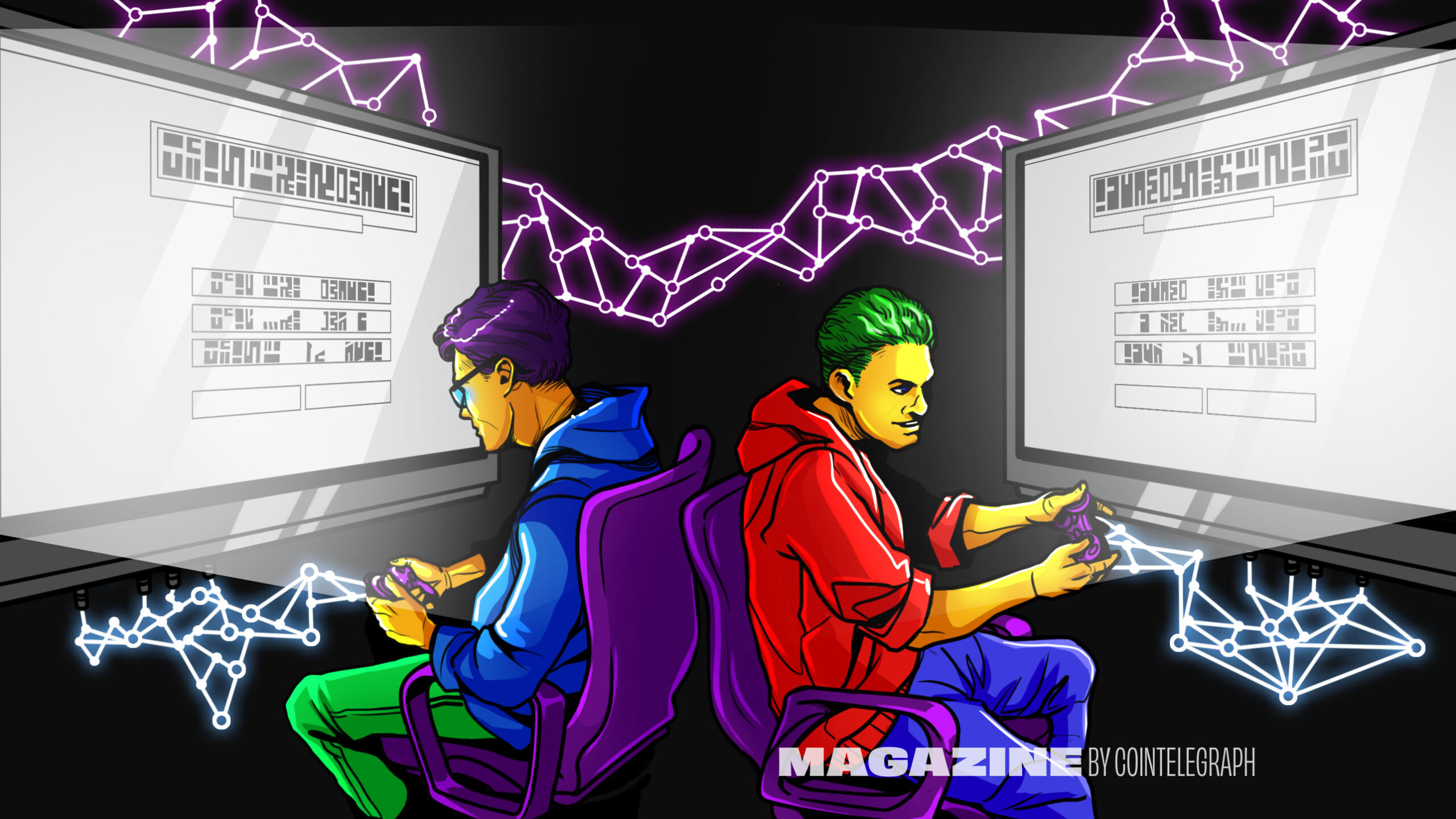
A ragtag group of communists and ZK-rollup fans are working tirelessly to make blockchain games composable and fully on-chain. It’s not easy.
Despite promises of decentralization and trustless ownership, the vast majority of crypto games today are, at best, partially decentralized. Web3 is the branding, but in reality, most are Web2+. Game assets live on-chain, yet the game logic, state and storage remain off-chain on centralized servers.
Why? Simply put, its not easy to build a fully decentralized game on-chain. Blockchains in 2023 are still far too slow for processing the gargantuan number of transactions that video games require. Lattice CEO Ludens tells Cointelegraph:
Building a fully on-chain game right now is a little bit like building video games on a computer from the 1980s. We dont yet have complex on-chain games yet because the blockchains even Layer 2s are not powerful enough right now.
Furthermore, developers have to make important tradeoffs when using blockchain technology to make the game widely accessible to non-crypto audiences.
For instance, Aurorys developers created a hybrid inventory system called Syncspace, which allows players to leave their assets in Aurorys custody, but move them into their Solana wallets if they wish.
Syncspace is Aurorys UX strategy, Julien Pellet, Aurorys infrastructure technical director, tells Magazine. Not every player wants to handle the complexities of a crypto wallet. We accepted that tradeoff by building Syncspace and allowed some assets to live off-chain in order to bring Aurory to a wider audience of non-crypto-native Web2 players
But there are passionate communities of degens interested in full-fat, on-chain autonomous worlds that are built from the bottom up by the players. One group even modded a game to form a communist collective so everyone won the same. Autonomous worlds, as theyre sometimes known, face a lot of hurdles, but given the limitations, the early results are impressive.

How Web3 games started
Web3 games are grappling with a bunch of other issues due to the brief history of the emerging sector. During the last crypto bull cycle, most blockchain games tried to be financial products first and video games second.
That strategy helped catapult the play-to-earn gaming sector into brief mainstream prominence when token prices were going up. But unfortunately, if the appeal is based on delivering a financial return, then enthusiasm can disappear fast when token prices take a dive.
Games like Axie Infinity, Pegaxy or Crabada, which once promised spectacular returns for players, have since fallen off a cliff. For Axie, unique active wallets peaked at around 700,000 in November 2021 but now tally more often in the eight to 10,000 range today.
The Metaverse Index (MVI) token, which tracks a collection of major gaming and metaverse tokens, is down 95.6% from its all-time high in November 2021.

In response, Web3 games are now shunning the play-to-earn catchphrase that helped propel the sector to prominence, embracing phrases like play-and-earn or play-and-own, and deemphasizing the profits while focusing on benefits such as the ownership of game assets, or simply how fun the game is.
At the end of the day, the core focus of games should be leisure and entertainment, not delivering a financial return, Aurorys backend tech director Jonathan Tang tells Magazine.
As Web3 game developers, our job is to think of how to leverage blockchain technology and what it brings to video gaming, while keeping the game fun as a priority.
Some believe the emphasis on financial returns has tainted the industrys image, not least due to an influx of scammers.
Pellet adds: The last bull run attracted scammers that have multiple elaborate strategies such as cloned websites and fake projects to divert millions of dollars from legit players and teams. With Web2 games, its much harder to pull off those types of scams.

Enter on-chain games
Encouragingly, however, a smaller community of builders interested in building autonomous worlds are trying to bring on-chain maximalism to blockchain games.
In contrast to their Web2.5 counterparts, fully on-chain games have their assets, and the game logic, state and storage live on-chain. The game state refers to the current status of the gaming world, such as player progression and the items they possess, while game logic simply refers to the rules of the game how players move, interact, collect and consume.
Why bother with having it all on-chain? Doing so ensures the games state is always immutable and transparent on the blockchain. But most importantly, it opens the door to the same kind of open composability that is possible in DeFi and enables an aggregator like the 1inch Network to build on top of Uniswap or Curve to integrate Synthetix and allow for cross-asset swaps.
Composability allows anyone to build second-layer rules on top of the games original rules. Second-layer rules in fully on-chain games exist in the form of smart contracts on top of the core game developers original smart contracts. They are simultaneously experienced by all players in the game, unlike third-party mods in traditional gaming that simply alter the players local gaming experience.
Collective action
Take, for example, the on-chain RPG Dark Forest, built on the Gnosis chain in 2019 by pseudonymous creator Gubsheep. Dark Forest saw groups of players in their own DAO (DFDAO) creating permissionless guild systems through external smart contracts. With the guild system, small players were able to overcome collective action problems in competing against big whale players by pooling their own in-game resources together. As DFDAO put it in its blog:
Someone needs to beat orden_gg. Orden_gg has won twice in a row and is at the top of the leaderboard as we speak. If we band together for a collective victory, we can defeat Dark Forests unofficial raid boss together.

DFDAO co-founder toe knee told Magazine: The Astral Colossus (guild) was a mini game above the core DF contracts, but in the eyes of the DF core contract, it was just another player. Instead of being an EOA account like everyone else, it was a smart contract with custom logic that shaped how it would behave differently. This contract was non-upgradeable and verified so players could confirm for themselves that we couldnt change the rules and we couldnt keep their planets after they donated.
Dark Forest players have also created their own in-game marketplaces or even forked the game entirely onto a different chain/layer 2 Gnosis Optimism. The new game Dark Forest Arena introduced new gaming modes previously unavailable.

Communist take over
Or take another on-chain game, OPCraft, a Minecraft-inspired experiment built by the Lattice team on Optimism. Weeks into the launch of the game, one player, calling himself SupremeLeaderOP, created a communist society where any player that opted into the guild would give up all their resources and share them with every other player in the society.
These rules were not a social promise between players. They were binding and tied to an on-chain smart contract. SupremeLeaderOP could not, even if he so desired, rescind his promises to players or bend the rules of his communist guild. Some players saw the guild as a wacky fun experiment and immediately swore allegiance to the communist Republic, in the process, giving up all their in-game resources in return for access to the guilds collective treasury. As documented on the Lattice blog:
Once a player had become a comrade, they were able to through smart contracts that the Supreme Leader had deployed mine material for the government treasury and build using treasury material on top of government owned land! The Republic even had a social credit system to prevent freeloading comrades from spending more material from the treasury than they have contributed. Free loading comrades were not allowed to build anymore until they had repaired their social credit through contributing their labor.
In fully on-chain games, players can implement innovative changes rather than having to wait for a core developer to introduce the updates through a centralized patch. Its a level of bottom-up spontaneous creative expression that extends far beyond how we traditionally think of video gaming, but in the Web2 world, experimenters tinkering around on custom game mods eventually spawned billion-dollar game franchises such as Dota and Counter-Strike. Dota was first created permissionlessly as a mod on Blizzards Warcraft 3 game, while Counter-Strike was birthed from a mod on Valves Half-Life game.
The on-chain gaming space is nascent, and builders in this space still refer to fully on-chain games very differently. The popular autonomous worlds label was coined by Lattice Labs, but other builders in the on-chain space have referred to the concept as eternal games, infinite games or on-chain realities.
Although the terminology varies, the common denominator underlying these games is hard permanence on the blockchain. Just as smart contracts and tokens will forever exist on-chain, fully on-chain games remain fully uncensorable and alive long after a gaming studio abandons the game.
The tradeoff? Most on-chain crypto games currently resemble turn-based board games with simple game loops like Space Invaders and Pac-Man in the early era of video games.
Limitations, limitations, limitations
In creating the on-chain racing game Rhauscau, creator Stokarz tells Magazine he had to make a bunch of necessary tradeoffs in game design due to cost limitations.
The reason why most on-chain games follow a traditional board game design with minimal game logic is because executing it all on-chain is inexpensive. On the smart contract level, its a one-dimensional play with agents simply changing the positioning of the play.
Although Rhauscau is deployed on the layer-2 Arbitrum Nova, which boasts a throughput speed far higher than Ethereum mainnet, the game is still limited to simple game loops that last five minutes tops.
The first tradeoff with Rhauscaus game design was that it had to be centered around one simple game loop. Too complex games mean more transaction speeds, which would make it too costly for users to pay for it. Its similar to early mobile games like Cut the Rope, Stokarz added.
Partially decentralized Web2.5 games dont face the same trade-offs as on-chain games because the only crypto layer within their games is assets in the form of nonfungible tokens.
But they make an important sacrifice in another regard: the games open composability.
Future of on-chain games
No one denies fully on-chain games face an uphill battle, and scalability isnt the only problem.
Ludens emphasizes that the immature state of on-chain games is also due to game designers lacking a set of coherent guiding game design principles for building on blockchain ledgers. Game designers should think harder about how to harvest the full affordances of a blockchain ledger in their game design.
But blockchain and software infrastructure is an issue.
On old video games, we saw simplistic text adventure games first. When computers got faster, then came FPS games like Doom. With higher computational power on the blockchain, it will further increase what we can do with game design.

Getting chain infrastructure to a higher throughput would obviously help scale on-chain games greatly. It would allow sharding of the games state and executing it together on multiple chains at the same time.
On the software side of things, he wonders what game engines like Lattices MUD (multi-user-dungeon) will look like years down the road. Can MUD write powerful enough applications as we continue to push it?
Todays video game market is dominated by the Unreal and Unity game engines. Commercial game engines like Unreal only emerged in 1998 after decades of experimentation. Today, they serve as the go-to software framework for game developers to create a game efficiently with much less technical complexity.
MUD aims to achieve something similar for blockchain game developers. The software stack streamlines the task of building an EVM app with various development tools like an on-chain database.
On-chain and on ZK-rollups
Ethereums roadmap is built around scaling via ZK-rollups, and theres a big opportunity on the various layer 2s for game designers to take advantage of faster and cheaper transactions. A small collection of builders on Starknet believe that the layer-2s zero-knowledge proof native architecture is much better poised to scale a fully on-chain game.
Cartridge is building its own game engine called Dojo, among other developer tools for Starknet game developers. Its founder, Tarrance van As, believes that Starknet is the only one with a tractable path to scalability for hundreds of thousands of users eventually.
With Dojo, game developers get a baseline capability of the framework because everything is provable all the time, he tells Magazine.
In the future, your game is not even going to be a layer 2 but a layer 3 or layer 4 on top of Starknet, he says, referring to bespoke blockchain environments designed for specific types of applications that are built in another layer on top of the layer 2. But he adds ZK-proofs can even be generated on the same local PC running the gameplay.
With ZK-proofs, you can even have logic computed on the client itself. We may even be able to run the game on our local device and simply provide the proofs that it was done correctly thanks to the mathematical integrity of ZK-tech.
Van As sees a world of opportunity opening up and believes that in years to come, on-chain games will resemble blockchains a lot more than traditional AAA games.
On-chain games are free from the restrictions of traditional game publishers such as a financial runway, development cycle and its closed nature. They resemble Ethereum much more in the sense that it evolved from an emergent, bottom-up culture.