We must learn from the historic collapse of Sam Bankman-Fried’s FTX cryptocurrency exchange before the world economy suffers a similar fate.
This is an opinion editorial by Captain Sidd, a finance writer and explorer of Bitcoin culture.
If you haven’t heard, one of the largest crypto exchanges, FTX, was the latest in a number of dominos to fall in the crypto “industry.”
The founder of that exchange, Sam Bankman-Fried, had evolved into a media darling over the past two years — gracing the cover of Fortune magazine and earning interviews with the likes of CNBC and Bloomberg. SBF, as he’s often referred to, studied physics at MIT and spent time at the renowned arbitrage trading firm Jane Street. He styled himself as the nerdy gigabrain, with a messy mop of hair and a penchant for sleeping in the office while building a financial empire just so he could donate it all to charity.
With the collapse of FTX and the closely-associated Alameda Research fund, the pessimistic view of SBF paints him as a scammer. He very well could have tricked investors and millions of retail clients by eschewing the classic, slick crypto con-man with his nerdy veneer and boyish face. Another theory points to his ties to U.S. regulatory agencies and the fact that he was the second-largest donor to President Biden’s 2020 campaign: perhaps SBF was a government plant. Maybe the fall of FTX was all part of a plan, providing a perfect “emergency” to usher in regulation of Bitcoin and other decentralized tools that threaten the existing world order.
As more information comes to light day by day, there are many data points to support the view of SBF and his cadre as nefarious fraudsters. However, the point of this article is not to take that view and tear them apart. The point of this article is to take the view that SBF and his crew were talented, ambitious and altruistic entrepreneurs who made several, admittedly large, mistakes out of their own desire to make the world a better place.
Why take this view? What it suggests about other presumably benevolently-led organizations is damning. This view reveals a critical insight about the state of leadership in our world today and what we can do to fix it — before the world economy we all depend on suffers the same fate as FTX.
SBF The Altruist
In many of Sam Bankman-Fried’s media appearances, he mentioned his belief in a philosophy known as “effective altruism.” The media ate it up, often running with headlines emphasizing that he wanted to give away his fortune to charity and maximize the amount of good he brought to humanity with his actions.
In his own view then, SBF’s support of struggling “decentralized” financial protocols, donations to mostly left-leaning political candidates and talks with DC politicians about crypto regulatory approaches were the best ways to harness his time and intellect for the greater good. But SBF’s quantitative mind seems to have led him out further than most in his pursuit of good.
As Sequoia Capital, one of the most prestigious venture capital firms and an investor in FTX, stated in its glowing profile of SBF: “To do the most good for the world, SBF needed to find a path on which he’d be a coin toss away from going totally bust.”
That profile, published just six weeks before FTX’s swift implosion, was titled “Sam Bankman-Fried Has a Savior Complex — And Maybe You Should Too” with the subtitle “The founder of FTX lives his life by a calculus of altruistic impact.”
That mentality of risking it all to accelerate the impact he could have on the world may have led him to take on debt he couldn’t repay and ultimately use funds earmarked for users in order to further his goals. SBF’s gambles may reflect his own rigorous, mathematical take on the vague mantra behind the effective altruism movement: “Effective altruism is a project that aims to find the best ways to help others, and put them into practice.”
Even though this behavior led to a coin-toss scenario — get huge or go bankrupt — SBF was clear throughout in his belief that this was the impact-maximizing path for humanity. Maybe to him, it was worth the risk if it helped the traditional financial system decentralize more quickly.
However, outside SBF’s mind and calculus, what he did looks remarkably different.
The Altruistic Fraudster
In the world occupied by those who SBF claimed he wanted to help, we find utter devastation from his reckless actions. No matter his intentions, millions of retail traders were left locked out of the FTX exchange overnight, just after SBF publicly announced that “Assets are fine.” Not even 24 hours later, SBF deleted that tweet and replaced it with a misleading message that Binance agreed to acquire FTX to solve “liquidity crunches.”
Over the following few days, the massive hole in FTX and its associated companies became starkly apparent. Several users may have bribed FTX in order to withdraw funds when FTX falsely claimed only Bahamian residents could withdraw. Later, information came to light that SBF had a backdoor in to FTX’s accounting system, allowing him to move funds without alerting others.
The pedigree attained by SBF and FTX drew in investors and lenders from across the financial ecosystem, from major VC firms like Sequoia Capital to the Ontario Pension Fund. FTX’s failure thus caused painful markdowns for many of those investors, and no doubt a number of further implosions in what may resemble a 2008-style contagion event. The crypto lender and savings account service, BlockFi, was the first to halt user withdrawals of funds in the wake of FTX’s failure — but it may not be the last.
To many outside observers, all of this looks like insider fraud, clear as day.
SBF lied through his teeth, abusing trust and possibly personally absconding with user funds as the exchange was imploding. However, to SBF, the collapse of his empire might seem to be simply poor luck, a bad coin toss in the game of leverage and misappropriation he was playing in order to do the most good as fast as possible. For a normal person, it takes some serious mental gymnastics to justify his actions, but to SBF they might have simply been the ugly means to a positive end for all humanity.
Again, I am not endorsing this view of SBF as an altruistic person fighting for the most good. All I am trying to show is that this view of him is not incongruent with the crimes he committed and the massive losses taken on by the clients and investors that trusted him and his team.
In fact, this view of SBF tells us much about the wider world of politics, and the risky financial behavior politicians engage in — apparently for the benefit of their constituents.
The Altruistic Politician
SBF may honestly believe living on the razor’s edge of bankruptcy allowed him to maximize his positive impact on the world. Unfortunately, how we fund our governments today shows our politicians follow a similar logic.
While you may believe the vast majority of politicians are nefarious ghouls, out to suck the life blood out of the common man to fund their private jet flights and pet projects, I will assume they have the best of intentions. Perhaps many politicians do believe the regulations they want to pass, taxes they want to alter or projects they want to fund will drive positive change. That is immaterial to my argument.
What I will argue is that due to their reckless funding method, the result of even altruistically-driven spending by politicians will result in a mess indistinguishable from fraud, just as we saw in SBF’s case.
What is this reckless funding method? Excessive government debt.
The State’s Reckless Financing
SBF may have recklessly used customer deposits and lines of credits in order to fund projects he believed would positively impact the world — leading to the swift collapse of his company and a near-total loss of customer funds.
Unfortunately, our governments are doing the same with our savings and wages, on a mind-bogglingly large scale. How?
In government, central planners pick an end they want to achieve — the elimination of poverty, or drug addiction, or high healthcare costs for example — and spend against it. When we pay into that system via taxation, with the money going in equaling or exceeding the money going out, there is no accrual of debt, and therefore no risk of bankruptcy.
However, our governments are currently addicted to debt. Since President Nixon ended the U.S. dollar’s tie to gold in 1971, all currencies around the world suddenly became “fiat” — their value not backed by anything but trust in that government’s ability to pay down its debts.
Since 1971, government debt around the world has ballooned in size. When a government takes on debt, it expands the liabilities side of its balance sheet. This creates risk — an obligation to pay against uncertain revenues in the future.
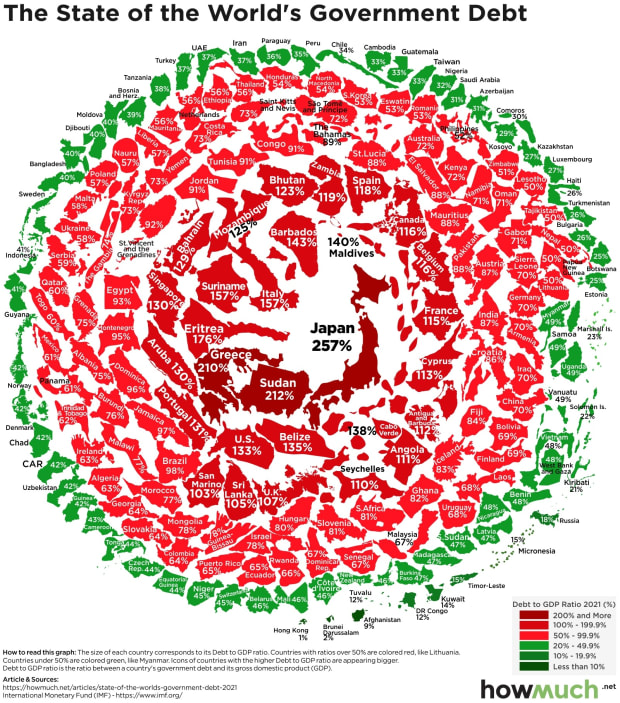
Many governments today carry debt burdens exceeding their entire GDP — including the U.S. Even if politicians spent all the money raised by issuing that debt on programs they genuinely thought would help citizens, there is now a huge hole in the balance sheet that needs to be paid back.
To a politician with good intentions, repeatedly taking on debt to pay for ongoing government programs and servicing existing debt might look like simply doing the most good for citizens and the world. Doing what is necessary to tackle the great crises at hand, even when that leads to an accelerating debt burden.
To outside observers, however, this activity should be indistinguishable from fraud.
So why are irresponsible governments still in business?
Governments Are Special
First, governments are just like other businesses in that their debt-fueled spending schemes survive off trust. Creditors must trust that the government will pay down its debts at some point. However, governments have a few extra tools up their sleeves than a normal corporation in order to keep paying down their excessive debts.
First, many governments can simply print money to lower their liabilities. While you and I have to work to pay off our debts, a government’s central bank can simply buy the government’s debt and hand over billions with a few keystrokes. Other schemes like minting a trillion-dollar coin achieve the same ends. All of them take value from all holders of that currency — hurting the lower end of the socioeconomic spectrum which keeps a larger portion of its assets in cash — and give it to the government.
Printing money worked well from the 1980s up until 2021, when inflation in real goods took hold. Prior to 2021, inflation mainly affected asset prices like equities and real estate while driving a wealth gap through the Cantillon effect. Post-2021, consumers are feeling sharp pain from rapidly rising costs of staples — energy and food — and that means the pitchforks are coming out. Many central banks rightly understand their excessive printing and low interest rates led to this outcome, so the ability to print more cash is now limited for the first time in decades.
Without the money printer, how can governments continue to retain the trust of their creditors that they can pay down their debts?
Cue the second tool of governments to pay down their excessive debts: violence and coercion. We’ve given governments a unique monopoly on violence, which they can use to compel their citizens to pay up. Just the threat of fines and jail time is enough to intimidate many into complying with increased taxation or financial controls, like those which may come with a central bank digital currency (CBDC). One only has to look to China to see how a CBDC can be used to micromanage the finances of individuals in the name of the greater good — as defined by the ruling class.
Government use of money printing and violent coercion mean citizens, not politicians, end up footing the bill for the collapse of state finances driven by the reckless debt burdens taken on by politicians. Those politicians may even support the use of violent coercion and money printing to keep the funding going, believing the pain to others to be worth it on the journey to a greater good they’ve defined. Similarly, depositors at FTX will foot most of the bill for the exchange’s reckless use of their funds.
To politicians and SBF, this may feel like honest mistakes and rough patches on the road to helping others as effectively as possible.
To everyone else, it is indistinguishable from fraud.
Are You Begging To Be Crushed?
The entire global financial system looks about as bad as FTX’s books right now, and the only thing that’s keeping it from unwinding is our trust in it. From a citizen’s point of view, we are trusting that our governments will effectively extract value from us to pay for the misadventures and financial risk-taking of politicians.
The solution for citizens is exceedingly simple — withdraw from the monetary and financial system that is designed to crush you. That system can only survive if we, collectively, trust it enough to store our hard-earned money in it. If we withdraw from it in droves, the entire ruse vaporizes — just like FTX.
If you are one of the first ones to withdraw from the existing financial system, you may keep your value intact — just as those who were quick to withdraw from FTX were made whole, before the assets dried up. Those who are too late to withdraw will be left with pennies on the dollar, punished by the taxation, control and money printing governments will need to engage in just to survive.
What does it mean to withdraw in a world where governments can freeze your bank accounts and take your property based on only suspicions of a crime, even in the most developed jurisdictions?
Withdrawing is about distance: How can you put the most distance between your assets and the fraud? I’ll leave it to you to find the form that takes in your situation, as each of us is completely unique. For me, it’s unforgeable digital money that moves at the speed of light, and lives everywhere and nowhere at once: Bitcoin.
Whatever it is for you, I hope you take action sooner rather than later.
This is a guest post by Captain Sidd. Opinions expressed are entirely their own and do not necessarily reflect those of BTC Inc or Bitcoin Magazine.