This is an opinion editorial by Roy Sheinfeld, the co-founder and CEO of Breez, a Lightning Network mobile app.
The more wonderful something is, the more passion it will arouse. Bitcoin is among the greatest wonders of the late-modern world, so Greg Foss is understandably very passionate about it. So passionate in fact, that he dropped 11 f-bombs in 31 seconds out of concern for its future (and this despite the fact that he’s Canadian!).
Why is such a stalwart Bitcoin proponent so concerned? Because two guys in cheap wizard costumes did a cringey Fortnite dance? Surely the stakes must be higher.
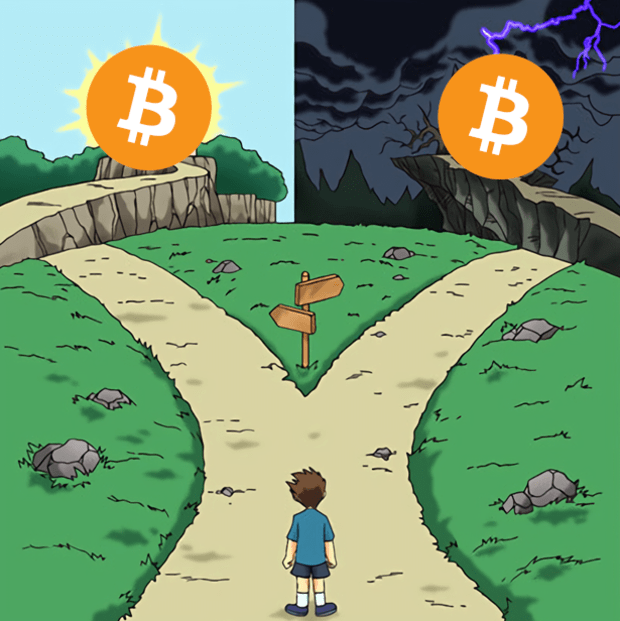
According to some, there is a battle underway for the future and soul of Bitcoin. According to others, we’ve just gained a fun, nerdy and innocuous way to play with Bitcoin that makes it even funner and nerdier, though no less revolutionary.
Ordinals, inscriptions and the BRC-20 protocol are the bone(s) of contention. Ordinals allow individual sats to be identified; inscriptions allow objects like text, images and data files to be written onto them; and BRC-20 allows second-order tokens to be minted directly onto them, like an Ethereum-lite. In effect, they introduce storage as a new use case for the Bitcoin blockchain in addition to its existing and principal use as a ledger for currency transactions. These features are affecting block sizes, transaction fees and validation times, so they’re not inconsequential.
The bone of contention is what they mean for Bitcoin’s future. Are they pathological, like a tumor? Do they offer a competitive advantage, like chlorophyll and claws? Or are they just harmless and benign, like male nipples or that little dangly thing at the top of your throat?
Ordinal ABCs One, Two, Threes
Of the recent developments in Bitcoin listed above, Ordinals came first. Casey Rodarmor, the guy who “invented” Ordinals (this time around), sought to devise “stable identifiers that may be used by Bitcoin applications.” In other words, he wanted to index sats by giving each one a serial number that would survive across time and UTXOs.
Of course, giving each sat a unique identifier means that they are no longer perfectly fungible because they are no longer strictly identical, when applying the Ordinal convention. Just like the Library Of Congress Classification (LCC) system for books in research libraries or URLs for web pages, Ordinals make each sat unique and retrievable. Identifiability affects fungibility without eliminating it.
Inscriptions are the second controversial, recent development in the world of Bitcoin. The “Ordinal Theory Handbook” gives a marvelously succinct definition of inscriptions, helpfully relating them to Ordinals:
“Inscriptions inscribe sats with arbitrary content, creating bitcoin-native digital artifacts, more commonly known as NFTs… These inscribed sats can then be transferred using bitcoin transactions, sent to bitcoin addresses, and held in bitcoin UTXOs. These transactions, addresses, and UTXOs are normal bitcoin transactions, addresses, and UTXOS in all respects, with the exception that in order to send individual sats, transactions must control the order and value of inputs and outputs according to ordinal theory.”
Of course, Bitcoiners are far too sophisticated to get suckered into all that Bored Ape nonsense. If we were to copyright cartoons on our blockchain, we’d do wizards instead of apes. I mean, apes? C’mon.
Whatever. Think of inscriptions like blockchain tattoos. Some people are going to love them, others are going to disdain them. The world (and the witness data of a transaction) is big enough for both.
The third recent development in Bitcoin is the BRC-20 protocol, which lets people mint and distribute tokens according to predefined parameters. These tokens are written as inscriptions onto sats marked with Ordinals, which brings us full circle. These three features allow users to create digital artifacts/NFTs and to use the Bitcoin blockchain to distribute and trade them.
So, how’s it going? Not surprisingly, some people are attracted to particular numbers, like one, seven or 69,420, so some sats are coveted because Ordinals have made them “rare” (although, if you think about it, each Ordinal number is unique, so each one is exactly as rare as the others).
There is also a market for BRC-20 tokens, many of which are just second-order bitcoin. For example, the $OG$ token and the $PIZA token both have a supply of 21 million (just like bitcoin) and, at one point, had market caps of around $10 million.
The upshot is that:
- Sats are now uniquely identifiable according to a new convention
- People can add data to sats
- Token-minting algorithms are a kind of inscription data, so people can mint tokens on the Bitcoin blockchain
It’s important to note that, while Ordinals, inscriptions and BRC-20 are recent developments in how Bitcoin works and how we use it, they’re not really “innovations” because they’re not really new. Something like Ordinals was proposed under the name BitDNS back in 2010. Using OP_RETURN to store strings of data on UTXOs goes back nearly a decade. And minting second-order “tokens” on an underlying blockchain is basically the idea behind Ethereum, which isn’t really new. (Hat tip to Giacomo Zucco, who took a deep dive into this in a presentation he gave in Prague.)
What This Means For Bitcoin: Transaction Fees
Ordinals, inscriptions and BRC-20 tokens are, of course, controversial. Though some love them, as the transaction fees of recent months attest, others are bemused or annoyed. Even the guy who invented BRC-20 has said, “These will be worthless. Please do not waste money mass minting.”
OK, but “worthless” isn’t a synonym for “evil.” Some people think tattoos and Big Macs are worthless, other people love them. So, what’s the big deal?
Opposition to Bitcoin’s new features usually stems from the suppositions that:
- Ordinals and inscriptions make bitcoin less like money
- They make transactions more expensive
Let’s deal with the last point first. Thanks in part to Ordinals, the number of transactions in the mempool has increased by about two orders of magnitude, and the data in the backlog has increased about 150 times.
The effects are ambivalent. On the one hand, more data per transaction increases the storage and computing burdens for node operators, for which they receive no compensation. Not great.
On the other hand, more data to compute means higher fees for miners. In fact, the average on-chain transaction fee reached $30.91 recently. High on-chain transaction fees are not evil. In fact, high fees are a good thing. They incentivize miners, which attracts miners and spurs them to invest, which keeps the hash rate high and makes Bitcoin more secure. That’s about as evil as a St. Bernard carrying a cask of brandy.

Moreover, high on-chain fees merely reinforce the different use cases between on-chain bitcoin and sats on the Lightning Network. On-chain payments have arguably never been well suited for quick microtransactions because they treat small and large transactions pretty much the same. By contrast, Lightning fees are proportional to the transaction amount. If you’re paying two-, or three- or 10 times the price of your beer or pizza in transaction fees for an on-chain payment when you could be paying one one-thousandth of it on Lightning, you’re doing it wrong.
If on-chain fees are inhibiting you from paying with bitcoin, then you should probably take advantage of Lightning’s proportional fees. If Lightning fees are inhibiting you from paying with bitcoin, then you should probably take advantage of the one-size-fits-all, on-chain fees.
What This Means For Bitcoin: Money-ness
As for whether bitcoin is still money in a world of ordinals, there are a couple of ways to answer that question. First, we could comb through various definitions of what money is, come up with the ultimate list of criteria and use it to evaluate the Bitcoin white paper and all subsequent protocols. Aristotle would be proud, but the answer would be unnecessarily theoretical and abstract.
Alternatively, we could actually observe what people are doing out there in the world. However sensible this new use case is, people like inscriptions and are willing to pay for them.
- Whom are they paying? Miners.
- How are they paying? Transaction fees.
- What are miners doing with the transaction fees? Reinvesting some to cover the costs of mining more bitcoin.
- Where does that bitcoin go? From the miners out into the world, where it circulates.
And there we have it: payment and circulation. People pay miners, miners pay people, they’re using bitcoin, ergo bitcoin is money. We’ve found the essence of currency without a dictionary (sorry Aristotle).
In other words, bitcoin is still money, but the Bitcoin blockchain can also be used for storage. Note the Boolean operator: (money and storage) not (money or storage). Indeed, adding new, sensible use cases might be a prerequisite for any currency from this point forward. The question is merely, what counts as “sensible”? But time — and the market — will tell.
Good, Bad Or Benign?
So, let us return to the original question: Are Ordinals, inscriptions and BRC-20 good or bad for Bitcoin? Or are they just a new feature of the world that we’ll adapt to without much consequence?
Well, these functions weren’t at the top of my personal list of priorities. I can’t say that Taproot Wizards or “Ordinal tokens” are really making the world a better place.
But I don’t fear these developments either. They raise fees, and higher fees have beneficial side effects for the blockchain. What’s good for Bitcoin is good for the world, whether it’s intentional or not.
And they reinforce the case for Lightning as a low-fee means to use bitcoin as money for smallish, everyday purchases and transfers. Generally, what’s good for Lightning is good for Bitcoin, which is good for the world. Wizards GIFs and subsidiary tokens can’t really do much harm, so I’m just gonna stay cool, stack sats and continue making Lightning as good as it can be.
This is a guest post by Roy Sheinfeld. Opinions expressed are entirely their own and do not necessarily reflect those of BTC Inc or Bitcoin Magazine.