
Key takeaways
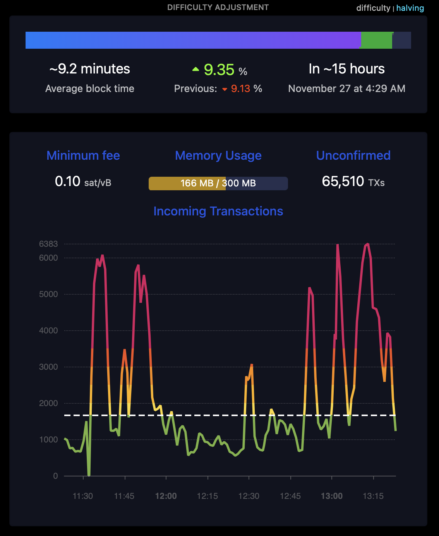
- Bitcoin mining difficulty is on course to rise about 9% on November 27, from 134.82 trillion toward 147 trillion, reversing much of the 9.13% cut on November 14.
- Under otherwise unchanged conditions, a 9% increase cuts expected BTC output per unit of hashrate by roughly 8.3%.
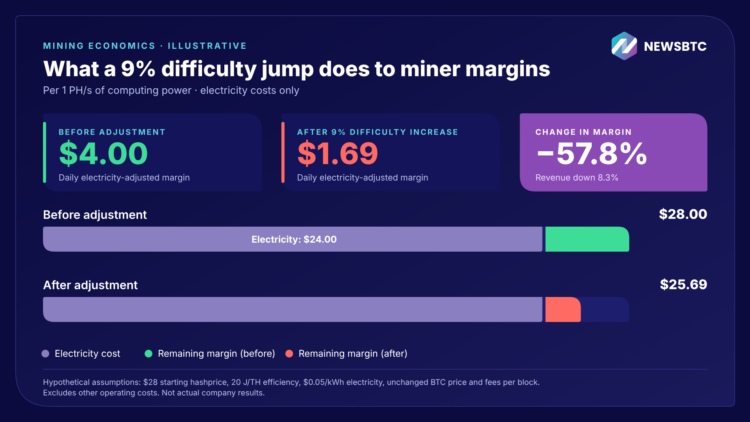
- At about $28 per petahash per day, a fleet running at 20 J/TH and $0.05/kWh would see its electricity-adjusted margin fall from about $4 to under $2.
- The effect is uneven: efficient operators with cheap power can absorb it, while older fleets may switch machines off.
- Difficulty alone is not evidence of more miner selling; miner balances, exchange transfers and treasury disclosures are.
Bitcoin mining difficulty is on course to increase by approximately 9% at the next network adjustment, expected on November 27. The increase would reverse much of the relief miners received less than two weeks ago, leaving operators facing tougher competition for block rewards while Bitcoin trades well below its previous highs.
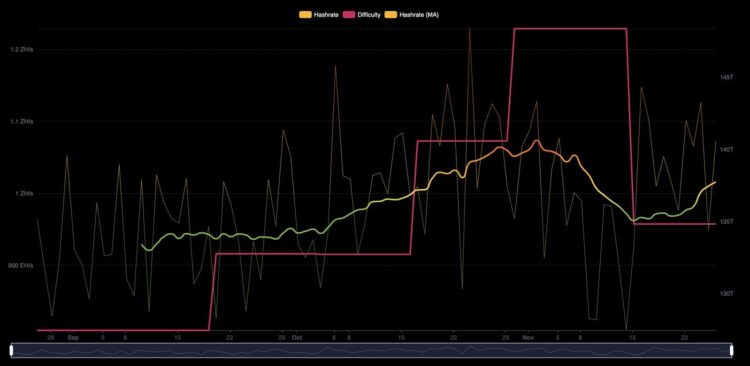
Current network estimates put mining difficulty at 134.82 trillion, following a 9.13% reduction on November 14. If the projected increase holds, difficulty will climb back toward 147 trillion.
For miners struggling to keep their machines profitable, the timing is hardly ideal. The electricity bill remains largely unchanged, but the same hardware could soon generate less Bitcoin.
Bitcoin Mining Difficulty Is Reversing November’s Relief
Bitcoin adjusts its mining difficulty every 2,016 blocks to maintain an average block production time of approximately ten minutes.
When blocks are produced too quickly, the network makes the mathematical conditions for discovering new blocks more demanding. When production slows, difficulty moves in the opposite direction.
The previous 9.13% reduction in Bitcoin mining difficulty gave active miners some breathing room. Operators could expect to earn more Bitcoin from the same amount of computing power, provided other conditions remained comparable.
That advantage now appears temporary.
The upcoming adjustment, expected at block 977,760, reflects a faster pace of block production during the current difficulty period.
A 9% increase in difficulty does not translate into an identical percentage reduction in mining revenue. Under otherwise unchanged conditions, expected Bitcoin production per unit of computing power would decline by approximately 8.3%.
Consider an operator whose machines currently generate 1 BTC over a given period. Following a 9% difficulty increase, the same machines would be expected to produce approximately 0.917 BTC over an equivalent period.
Nothing about the hardware needs to change for that reduction to occur. The network has simply raised the amount of work required to compete for its rewards.
The Real Problem Is What Miners Earn From Their Machines
Mining difficulty only tells part of the story.
A more useful measure of the industry’s financial condition is hashprice, which tracks the expected revenue generated by a given amount of computing power over a day.
Hashprice incorporates Bitcoin’s market value, network difficulty and transaction fee revenue. It provides a clearer indication of whether a miner’s hardware is generating enough income to justify keeping it switched on.
Recent network data from mining industry trackers puts daily hashprice at around $28 per petahash of computing power.
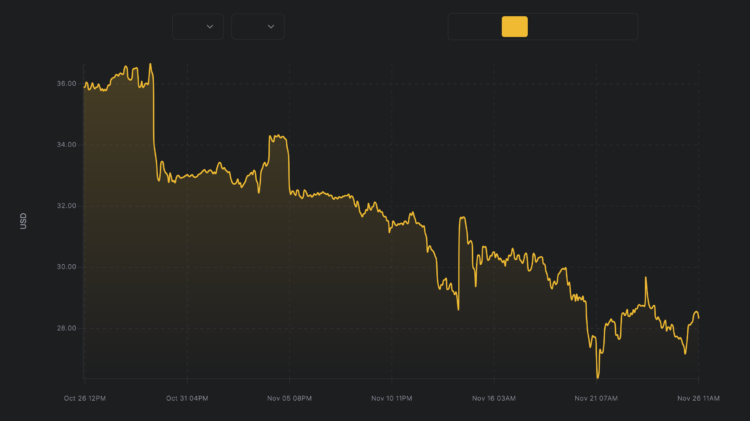
At that level, the economics can become uncomfortable surprisingly quickly.
Consider a hypothetical mining fleet with an energy efficiency of 20 joules per terahash and an electricity rate of $0.05 per kilowatt-hour.
Operating one petahash of computing power continuously would cost approximately $24 per day in electricity alone. Against $28 in gross daily mining revenue, that leaves just $4 before hosting, maintenance, cooling, financing and other expenses.
If difficulty rises by 9% while Bitcoin’s price and average fees per block remain unchanged, that daily revenue would fall to approximately $25.69. The remaining electricity-adjusted margin would shrink to less than $2.
The network adjustment is the same for everyone. Its financial consequences are not.
An operator with newer machines and inexpensive power may comfortably absorb the change. Another running older equipment could find that switching off part of its fleet makes more financial sense than continuing to mine.
Bitcoin Miners Are Already Rethinking Their Business Models
The industry’s response to difficult mining economics extends beyond upgrading machines or negotiating cheaper electricity.
Some established Bitcoin mining businesses are redirecting infrastructure toward artificial intelligence and high-performance computing.
Access to substantial electricity capacity, established data centers and existing infrastructure gives certain operators alternatives that smaller mining businesses may not have.
This does not mean Bitcoin mining is disappearing. The projected difficulty increase itself suggests that blocks are being produced faster than the protocol’s target rate during the current adjustment period.
But the growing divergence between mining operators deserves attention.
A Bitcoin mining facility with access to inexpensive energy and efficient equipment operates under a very different set of economic conditions from a business relying on expensive financing and aging machines.
Rising difficulty does not necessarily make the entire industry unprofitable. It makes the difference between efficient and inefficient operators harder to ignore.
Does Higher Mining Difficulty Mean More Bitcoin Selling?
The prospect of shrinking margins raises an obvious question for Bitcoin investors: will miners need to sell more BTC to finance their operations?
There is a plausible case for additional selling from businesses facing substantial operating expenses or debt repayments. Mining companies cannot generally settle their electricity bills with anticipated future Bitcoin rewards.
However, network difficulty alone provides no evidence that miners have increased their Bitcoin sales.
Some operators hold substantial treasury reserves. Others sell their production regularly, regardless of market conditions. Businesses can also reduce operating expenses, shut down inefficient equipment or obtain financing instead of liquidating additional holdings.
Actual miner balance data, exchange transfers and company treasury disclosures will provide more useful evidence than the difficulty adjustment itself.
The immediate development to watch is whether the estimated increase materializes at the next adjustment block. After that, hashprice and changes in network computing power will help reveal how operators are responding.
Bitcoin’s protocol is doing exactly what it was designed to do. It adjusts the competition for block rewards without considering whether individual mining businesses can afford to remain competitive.
The machines that become uneconomical have always been the operators’ problem, not the network’s.