
The previous Bitcoin market top may not have been marked by a dramatic crash or obvious sell signal, but by a highly coordinated, sophisticated wave of whale distribution. While most participants were driven by optimism and bullish conviction, large holders were quietly offloading positions in a way that blended seamlessly into normal market activity.
How Whale Distributed Bitcoin Without Triggering Warning Signals
The Bitcoin market top last year was less obvious than in past cycles, unfolding through a quiet, highly coordinated wave of whale distribution. ForeDex on X revealed that at a time when BTC participants were filled with optimism and conviction, a whale moved roughly 30,000 BTC to exchanges over 10 days via Galaxy Digital. Meanwhile, most market participants failed to recognize the significance of these flows.
ForeDex explained that BTC was split into smaller amounts and distributed across multiple exchanges, unlike previous cycles. In earlier market tops, large flows often ranging from several thousand to 10,000 BTC were sent directly to platforms such as Coinbase, Binance, or Gemini in a single transaction, making these movements relatively easy to detect.
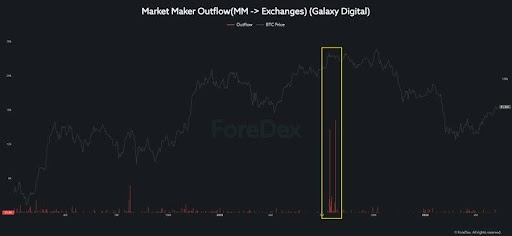
However, after the ETF approval, market structure and trading behavior became more sophisticated. As selling pressure was distributed across different exchanges, the historical exchange-specific sell premium became less reliable. Even the well-known Coinbase-Binance Gap data no longer shows these traces as clearly as it used to.
Ultimately, BTC market dynamics are evolving, and new patterns are constantly emerging. Even if some participants had identified unusual flows, the strong optimism and conviction at the peak would likely have led many to dismiss them.
Bitcoin Could Face Another Liquidity Sweep To The Downside
Bitcoin is showing signs of weakening market structure, with price forming lower highs following the rejection at $82,000. Crypto analyst Kaz has noted that one of the biggest warning signs is the sharp rise in Open Interest (OI) that is aggressively occurring, and both perpetual and spot Cumulative Volume Delta (CVD) are trending downward, indicating bullish traders are already starting to get squeezed out of the market.
At the same time, bears appear to be actively building short positions, a continuous liquidation that is adding fuel to the decline. Kaz argues that additional long positions could be flushed out, as perpetual and spot CVDs are currently declining, and there is still long liquidation at the downside.
Currently, BTC is retesting the $80,000 level with the highest OI bearish positioning seen at this level so far. In the bullish case, if price holds above the $80,000 zone and CVD starts rising, the market could trigger a short squeeze back toward the $82,000 resistance.
In the bearish scenario, a loss of the $80,000 level, combined with current weak internals, could lead to a liquidity sweep of the lows, with price potentially moving toward testing the point of weak order (pwO).