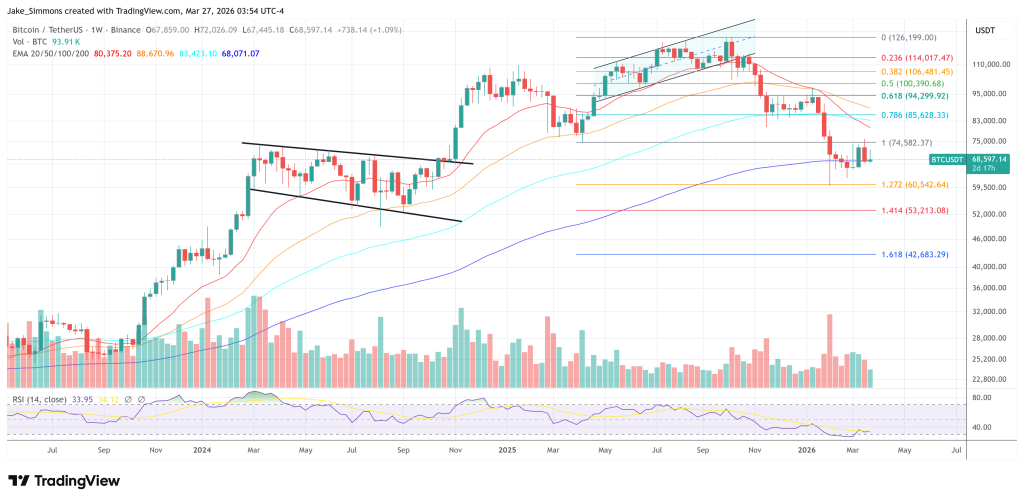
JPMorgan says the Iran war has produced an unusual market split: bitcoin is showing signs of safe-haven demand while gold and silver, the traditional geopolitical hedges, have weakened under the pressure of outflows, profit-taking and deteriorating liquidity.
In a report dated March 26, Nikolaos Panigirtzoglou and his team said bitcoin has held up better than precious metals since the conflict escalated. Gold is down about 15% this month, according to the bank, while gold ETFs recorded nearly $11 billion in outflows in the first three weeks of March. Silver has also come under pressure, with JPMorgan saying ETF inflows built since last summer have now been unwound, even as bitcoin funds continued to post net inflows over the same stretch.
Bitcoin Shows Safe-Haven Demand
That divergence is not just a price story. JPMorgan argues it is also visible in positioning and market structure. Gold and silver had become heavily crowded trades after a run that pushed gold close to $5,500 an ounce and silver near $120 earlier this year.
As rates rose, the dollar strengthened and investors moved to de-risk, those positions started to unwind. CME-based positioning shows a sharp drop in gold and silver exposure since January, while bitcoin futures holdings have stayed comparatively stable in recent weeks.
The bank’s explanation is more nuanced than a simple “bitcoin replaced gold” narrative. Bitcoin initially sold off with other risk assets when the war broke out, briefly falling into the low-$60,000 range before stabilizing back in the high-$60,000 to low-$70,000 area. JPMorgan’s point is that bitcoin did not behave like a classic shelter in the first shock phase, but it recovered as flows returned, while gold and silver kept losing support.
JPMorgan also tied that relative resilience to crypto’s utility in a stressed jurisdiction. “The deterioration in liquidity conditions in gold has seen its market breadth decline below that of bitcoin currently,” the bank wrote.
In a separate summary of the same report, JPMorgan said, “The surge in Iran’s crypto activity highlights the role of cryptocurrencies as a safe haven asset in countries experiencing economic and monetary instability and geopolitical stress.” The bank cited Chainalysis data showing increased Iranian crypto activity after the outbreak of war, including transfers from domestic exchanges into self-custody wallets and international platforms.
That combination of borderless settlement, self-custody and round-the-clock trading sits at the center of the bank’s argument. Bitcoin’s momentum indicators, which had fallen into oversold territory, are now moving back toward neutral, JPMorgan said, suggesting selling pressure may be easing.
Gold and silver momentum, by contrast, swung from overbought to below-neutral as liquidations accelerated. The bank’s liquidity work points the same way: gold’s market breadth has now fallen below bitcoin’s, while silver’s thinner depth has made its decline even more violent.
At press time, BTC traded at $68,597.