
Bitcoin’s (BTC) struggle to hold key price levels is raising fresh concerns across crypto markets, even as spot exchange-traded funds continue to control tens of billions of dollars in assets.
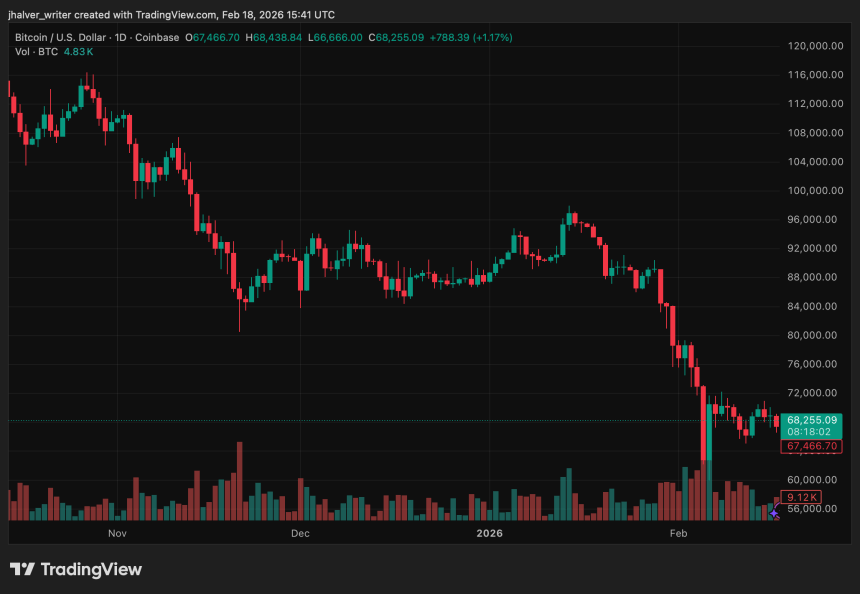
The largest cryptocurrency has fallen back below the psychologically important $70,000 mark, trading around $68,000 after weeks of steady selling pressure and weakening momentum.
While institutional products still hold significant capital, analysts say the market structure shows growing downside risk rather than stability, with technical patterns, whale activity, and macroeconomic uncertainty all pointing to a fragile outlook.
Bearish Chart Signals and Whale Activity Intensify Pressure
Technical indicators suggest the correction may not be finished. Market analysts highlight a developing “bear pennant” formation, a pattern that typically appears after sharp declines and often precedes another leg lower.
A confirmed breakdown could push Bitcoin toward the $55,000–$60,000 range, representing roughly a 20% decline from current levels.
On-chain data from CryptoQuant shows rising inflows into exchanges from large holders. The ratio tracking major transactions moving onto trading platforms recently reached elevated levels, historically associated with increased sell-side pressure. Analysts interpret this as preparation for distribution rather than accumulation.
Additional data suggests the market has entered a “stress phase,” with losses mounting among newer investors while long-term holders remain profitable. Similar setups in past cycles often preceded extended consolidation or deeper corrections before recovery.
Bitcoin ETFs Remain Large, But Not Necessarily Bullish
Despite price weakness, U.S. spot Bitcoin ETFs still hold about $85 billion in assets, equivalent to more than 6% of the circulating supply. However, analysts caution that ETF resilience may not reflect strong bullish conviction.
Research indicates a large portion of ETF ownership is dominated by market makers and arbitrage funds maintaining hedged positions rather than directional bets. Funds linked to asset managers such as BlackRock continue to see activity, but flows have recently turned negative, marking several consecutive weeks of net outflows.
Institutional positioning is also shifting elsewhere. Filings show Harvard University reduced part of its Bitcoin ETF exposure late last year, highlighting a more cautious stance among some large investors.
Macro Uncertainty And Sentiment Keep Markets On Edge
Broader financial conditions are adding to pressure. Bitcoin has remained closely correlated with technology stocks and risk assets, both of which have reacted to expectations of prolonged higher interest rates. Upcoming Federal Reserve signals and economic data releases are likely to shape the short-term direction.
Sentiment indicators tracked by Matrixport show extreme fear dominating markets, a condition that sometimes precedes rebounds but can also accompany late-stage corrections.
Meanwhile, corporate holders such as Strategy Inc continue accumulating Bitcoin despite volatility, underscoring a divide between long-term institutional conviction and short-term market weakness.
Cover image from ChatGPT, BTCUSD chart on Tradingview