The prospect of a “Trump Fed takeover” is rapidly becoming a central macro theme for 2026, with some traders arguing that markets still underestimate how radical the shift could be for global liquidity – and by extension for crypto.
Macro commentator plur daddy (@plur_daddy) describes it bluntly via X: “The Trump Fed takeover being underpriced is my primary theme going into 2026 (hence my gold bet). This is a momentous shift: the bigger and more convex the catalyst, the more difficult it is for markets to price it in properly.”
Former Fed trader Joseph Wang known as “Fed Guy” echoes the concern from inside the plumbing, warning: “The market underestimates the likelihood of a Trump Fed. The Administration is showing resourcefulness and determination for lower rates. That could set off the blow off top in equities, where implied vol shows speculation still has room to run.”
The Trump Fed Takeover Isn’t Price In
That determination is colliding with a bond market that appears to be pushing back via term premium. Plur highlights the spread between the 12-month T-bill and the 10-year Treasury as a clean gauge of that tension. He notes that the spread “peaked right before inauguration on the generic ‘Trump will run it hot’ viewpoint,” then “got crushed lower as DOGE and Tariffs got priced in.” It bottomed near the tariff lows and “is now back to the highs,” a pattern he reads as term-premium expansion as “a form of protest to [Kevin] Hassett,” Trump’s presumed Fed pick.
Against that backdrop, the administration still has powerful tools to compress term premium without formally announcing quantitative easing. Plur identifies three levers. First, de-regulating banks so they are allowed – in practice, pressured – to hold more Treasuries, boosting structural demand for government paper.
Second, reducing the Treasury’s weighted-average maturity by shifting issuance “to bills over longer dated notes,” which cuts the duration the market has to absorb. Third, specifically for mortgages, “lever up the GSEs to buy MBS,” narrowing mortgage spreads and transmitting easier policy to the housing market even if the policy rate moves more slowly. He argues that “all of these are quite bullish for risk overall but will take time to play out.”
For now, the environment remains awkward for directional risk bets, including crypto. “In the meantime, it has been a choppy and difficult market, across the board. Equity indices have grinded higher but the underlying rotations have been tricky to navigate. QT ended but liquidity is still relatively thin, and the fact that we are going into year end does not help. Better times will come.”
The bullish pivot in his framework arrives with the calendar. “In the new year, fiscal accommodation will re-expand on the implementation of OBBBA (+$10–15bn/mo). Meanwhile we have sell-side macro teams calling for $20–45bn/mo in T-bill repurchasing by the Fed, as soon as Jan 1.”
This mix would directly ease pressures visible in funding markets: “This would go a long way towards easing the current liquidity issues (see the SOFR–IORB spread chart below). This is not classic QE in that there is very little duration being absorbed from the private sector, and mainly has the effect of expanding bank reserves. This is still bullish because bank reserves are tight at the time, which is tied to the repo liquidity issues.”
Will The Crypto Market Rise Again?
On that basis, Plur expects the macro backdrop in 2026 to look “better than H2 ’25 has been, perhaps more on par with parts of 2024.” His expression of the trade is clear: “This should be enough for strong performance on gold given the Fed takeover angle, and continued melt-up in equities and select commodities.”
For Bitcoin and the broader crypto market, however, his stance is notably more cautious. “For BTC it is more difficult to say. My base case continues to be a frustrating period of chop and re-accumulation.” Improved liquidity “should be favorable for BTC,” but he questions whether there will be “a material shift in the supply/demand imbalances we have been seeing,” concluding: “I will keep watching it for now.”
In other words, the Trump Fed trade is already driving high-convexity bets in gold, equities and commodities. Crypto stands to benefit indirectly from easier reserves and lower term premium, but in this framework, the key constraint is no longer just macro liquidity – it is whether fresh demand is strong enough to meet an increasingly inelastic supply in the crypto market.
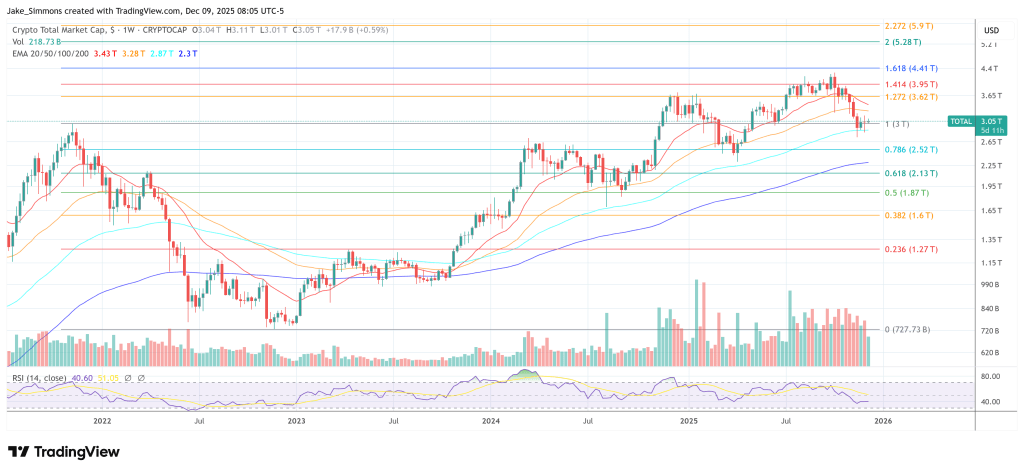
At press time, the total crypto market cap stood at $3.05 trillion.